
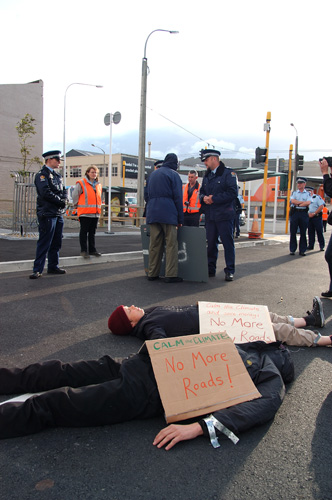
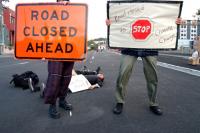
 28/12/06: The opening of the Wellington Inner City “Bypass” was delayed, as it was blockaded by protesters this morning in an action against new roads. Two people were nailed to the asphalt just before 7am at the corner of Taranaki and Arthur Streets. One person was arrested (15 cops showed up!) and was charged with obstructing a public way.
The long-awaited opening of the Wellington Inner City “Bypass” is/was delayed this morning, as it is/was blockaded by protesters who claim that new roads exacerbate climate change.
“The government could save billions of dollars, and slow climate change, by making a pro-active decision to stop building new roads,” said Charles Sylvester, a protester.
“It’s often said – for example in the Stern Report – that the potential costs of climate change massively outweigh the costs of reducing our emissions. But to stop building new roads would not even have a cost. In fact it would save billions – and help to stabilise our emissions. Every time we build a new road car-driving becomes easier, making people less likely to use the low-or non- polluting modes of transport such as walking, cycling, trains and buses. People also have to travel further due to small but cumulative increases in urban sprawl,” said Doris Brown, another protester.
“Our population’s collective total distance-travelled, and the percentage of people using each mode (bike, bus, etc), have a much greater influence on emissions than any “efficiency improvements” such as biofuels, hybrid vehicles and the reduction of idling time in traffic jams,” said Charles Sylvester.
“Billions of dollars may seem to be well-spent on new roads when cost-benefit analysis counts dollars but does not adequately recognise environmental and social values. Extending roading systems however promotes car use with money that could be used to improve public transport and provide further facilities such as cycleways to encourage walking and cycling,” said Doris Brown.
“The community here have struggled for over forty years to stop this so-called “by-pass” and we achieved a lot in terms of rescued buildings and a smaller road. The struggle is not over though. While political parties and greedy corporations squabble over who looks the greenest our global climate chaos worsens. People will not sit back and take it. The storms have come but seeds are sprouting. Expect to see more protest action!” said Charles Sylvester.
Melting icecaps, endangered Polar Bears and serious drought in Australia are “canaries in the mine” signaling a global climate change crisis that threatens the viability of weather and ocean systems on which life and civilisation depend.
“The GHG [greenhouse gas] problem is extremely dangerous to our civilization because we are predisposed to ignore it”, said Prof. Peter Barrett FRSNZ (Director, Antarctic Research Centre, Victoria University of Wellington) in an article originally published in the “Evening Post”, 10 May 2002 (www.gsnz.org.nz/gs_archive/gsprpb.htm). “If the shrinking trend [of the Arctic ice cap] continues at its present rate of 8 per cent a year, there could be no ice at all at the pole as early as the summer of 2060” reported the Dominion Post, 20 Sept, 2005, B1 summarising results of a study conducted by US National Snow and Ice Data Centre and NASA researchers. “Former U.S. vice-president Al Gore…visit[ed] Auckland [in November this year] to tell key business leaders and politicians in a closed meeting that they must act now to avert climate change catastrophe” (Sunday Star Times Oct 29, 2006, A1).
For further information see
www.sierraclub.org/sprawl/transportation/seven.asp
(seven articles in professional journals, showing that new roads induce new traffic)
www.vtpi.org (tranport policy analysis); www.livingstreets.org.nz (promoting walking)
www.option3.org.nz (people-friendly transport planning)
www.techmedia.co.nz/t2K/ (light rail etc); www.climatechange.govt.nz . (statistics)
www.hm-treasury.gov.uk (Stern Review)
Some red paint was discovered on the ‘bypass’ under Ghuznee Street by a photographer.
Links: Heartbeat | Climate IMC | Climaction | Option3 | Earth First! | Earth Liberation Front | Save Happy Valley
——–
Some notes on nail tactics:
Actually the nails were not very good, and only held the protesters down if they were VERY still. We used approx. 1.5 inch galvanised nails which were very hard to nail into the ashphalt, at least for a non-chippy, and they kept bending. If I had to do it again I would use 6 inch non galvanised nails and a decent hammer. I couldn’t see the need for galvanising. The nails were not going to rust off in the half hour or so the protesters were allowed to stay on the road.
I am not sure if police carry a claw hammer or jemmy, but if not, then then some decent nailing might have delayed the traffic until they could get one from the cop shop.
—
We tried the nails on another bit of asphalt that was newer and the nails went in really easily. The asphalt on arthur street was a bit older and compacted. Live and learn.
I think the galvanised nails were just ones they found and not specifically chosen for that reason.
And yeah it was more a photo stunt in order to get our voices heard… and it worked ;o)
Yay.
——–