
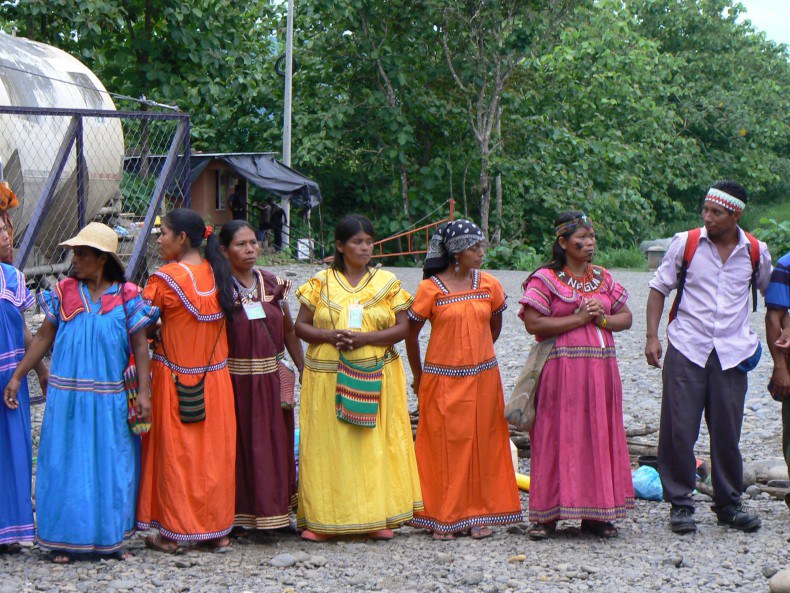
Ngäbe activists standing in front of the Barro Blanco dam site (Photo Jennifer Kennedy)
July 14th, 2015
A 30-strong splinter group of Ngäbe from the M10 resistance movement has blocked the entrance to the Barro Blanco hydroelectric dam in western Panama, preventing workers from entering the site. The 15 year struggle of the Tabasará river communities to protect their livelihoods, their culture, and their ancestral heritage now appears to be entering a tense new phase. With negotiations exhausted and the dam 95% complete, M10 has an issued an ultimatum for the government to cancel the project by Monday, June 15, 2015. It is unclear how the government will respond.
“Being Ngäbe-Buglé cultural patrimony,” said Clementina Pérez, part of the group camped at Barro Blanco’s gates. “Our river, our mother earth, our ecology, our existence, we are here to make known to the national and international community that this patrimony belongs to us and to the church of Mama Tata. With the conservation of peace, liberty, justice and unity, liberation and social justice… [we ask] the President of the Republic the cancellation and removal of the dam from our communities, our river and our mother earth, which belong to us as original people of the Americas…”Funded by European banks – the German Investment Corporation (DEG) and the Dutch Development Bank (FMO) – the dam is set to inundate a string of Ngäbe and campesino communities, all of whom have voiced their objections from the outset. The flood will destroy ancestral petroglyphs, fertile agricultural grounds, and Mama Tata cultural centres, including a unique school where the emerging written script of the Ngäbere language is being developed and disseminated. The dam will significantly impact the river’s marine life, wiping out migratory fish species which many communities – both up and down stream – rely upon for essential protein. None of the Tabasará communities have provided their free, informed and prior consent to the dam, a fact recently confirmed by the FMO’s own independent complaints mechanism (ICM).
“Lenders should have sought greater clarity on whether there was consent to the project from the appropriate indigenous authorities prior to project approval,” said an ICM report, published on May 29, 2015. “[The plan] contains no provision on land acquisition and resettlement and nothing on biodiversity and natural resources management. Neither does it contain any reference to issues related to cultural heritage…”
The report is the latest in a series of professional analyses that pour a thick layer of scorn over the dam project’s owner, Generadora del Istmo (GENISA). Demonstrably unlawful, GENISA has been condemned by numerous independent investigators, the United Nations, several international NGOs, and Panama’s own environmental agency, ANAM, who found a raft of flaws and short-comings in their environmental impact assessment.
But despite failing their own due diligence, the banks appear to have shrugged off the ICM report with an insipid call for ‘constructive dialogue’ and ‘a solution for a way forward’. In February this year, the FMO chose to threaten the government of Panama after building work was temporarily suspended on the recommendation of ANAM. Writing to the Vice President, the FMO warned that the suspension “May weigh upon future investment decisions, and harm the flow of long-term investments into Panama.”
The government seems to have taken this threat to heart. Panama’s president, Juan Carlos Varela, who was elected to office in 2014, flip-flopped on Barro Blanco before finally falling in line. Last week, while proffering flimsy reassurances about having found a human rights solution, his government left the negotiating table and signaled an end to the suspension of works. M10 claims the work never stopped and has been continuing clandestinely. They are now mobilising for action.
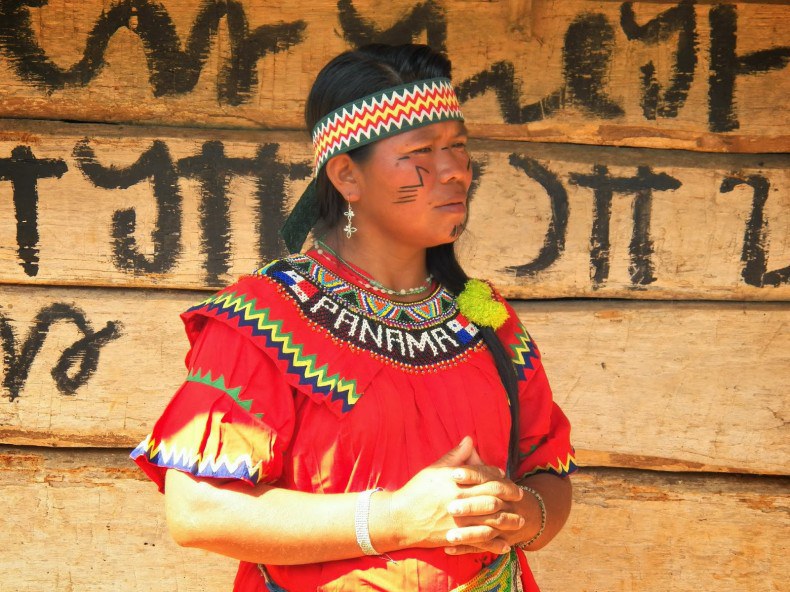
Clementina Perez (Photo: Oscar Sogandares)
“If this situation is not resolved,” said Clementina Pérez, “We will go to the Panamerican highway to ask together, at a national level, the cancellation of Barro Blanco…”
Rising with stark grey walls above the denuded banks of the Tabasará, Barro Blanco has become a symbol of the previous administration, its fundamental violence and contempt for the rule of law. The former President Ricardo Martinelli – now on the run in the United States and facing a corruption probe back home – provoked no less than four major uprisings as he grasped for land and resources in Panama’s indigenous territories. Heavy-handed repression resulted in the deaths of several protesters and bystanders, including an unarmed teenage boy who was shot in the face by police. Barro Blanco is the visible legacy of a proudly thuggish President who serially abused Panama’s Indigenous Peoples and plundered the country at will. Thus far, Varela has been keen to strike a more decent and humane tone. How he now handles the crisis evolving on the banks of the Tabasará River will be a demonstration of his sincerity, or lack of.
by IC Magazine