
 July 17, 2010
Environmentalists opposed to plans to raze a Khimki forest to make way for an $8 billion highway raised a barricade to keep out loggers Monday, Interfax reported.
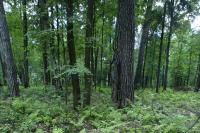
On the side of the road to Moscow’s Sheremetyevo Airport, which runs along a pristine expanse of old-growth trees, a banner urges drivers to help “Stop the felling of the forest.”
Behind the sign, the forest is marred by a gaping hole the size of three football fields.
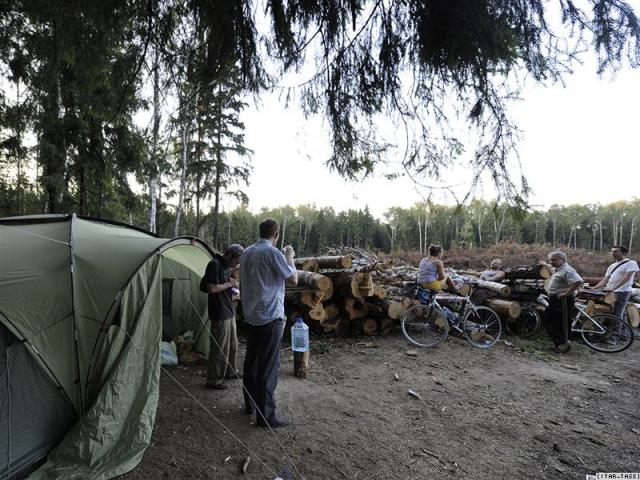
This is where activists from the Ecodefense environmental group have camped out in a desperate bid to save the Khimki forest from destruction.
Russian authorities want to clear large swathes of forest to make way for an $8 billion highway connecting Moscow and St. Petersburg. They say the proposed route through Khimki, a small town on Moscow’s northern outskirts, will help ease traffic congestion by offering an alternative road to the airport.
But environmentalists say building the highway in Khimki would deprive Moscow of yet another chunk of its fast-dwindling green belt, designed in the 1930s to contain pollution and preserve wildlife.
Ecodefense succeeded in halting the first felling works on July 15, because the workers showed up without deforestation permits, according to activist Sergei Ageyev.
“There were about six workers cutting down trees and two security guards. There were more at the other location, which had the bulk of the equipment, including an excavator. We demanded that they stop work,” Ageyev says. “We asked to see documents. They didn’t know anything; there were no documents at the site. It is a blatant violation; there must be documents.”
Ecodefense leader Yevgenya Chirikova says a small fight erupted between activists and security guards of the French company in charge of the felling, Vinci Concessions.
“We won,” she adds with a smile.
The company could not immediately be reached for comment.
Shortly after speaking to RFE/RL, Chirikova was attacked by an unidentified man, who struck her before ramming his car into her. She escaped unhurt.
She said the police were slow to respond when she reported the incident. “I don’t understand why it took them so long to find me,” she told RFE/RL’s Russian Service. “The day before a detachment of police was ordered to our camp and they had found us quite easily.”
Chirikova said the the attack was a form of “psychological pressure” and just one in a series of incidents meant to intimidate her.
Pollution And Illness
At the activists’ makeshift camp, freshly cut birch trees are piled up close to an abandoned bulldozer. Other piles of felled trees nearby suggest clearing has been going on for some time.
Despite the sweltering heat, the activists are determined to stay here round-the-clock until all felling equipment has left the forest.
Ecologists and Khimki residents have been fighting plans to build the highway for years, saying it will have a devastating effect on the local environment.
Andrei Margulev, the coordinator of the union of ecological organizations, was the one who raised the alarm about this week’s felling at Khimki forest.
“The ecological situation here in the north of Moscow is very dire due to the huge number of vehicles and enterprises, including garbage incineration plants and a famous garbage dump that constantly sends out smoke on that side of the canal,” Margulev says. “The forest filters the air and the dust that can carry pollution all the way to our lungs. All this dust remains here. If there were no forest, hundreds more people would die of cancerous diseases.”
Chirikova, a businesswoman, moved to Khimki with her family to live closer to the forest. She began campaigning to save the forest after she noticed red paint on trees near her home in Khimki marking the highway’s proposed route.
“The forest is important to us not only as a source of oxygen, but also for its biodiversity, which is unique for the Moscow region,” she says. “There are fewer and fewer such places, and we understand that if we don’t preserve this forest, we won’t survive next summer when temperatures reach 36 degrees Celsius.”
Charges Of Corruption
Critics of the highway accuse the government of ignoring protests, manipulating laws, and modifying the forest’s status to allow its deforestation.
The group filed a complaint to the European Court of Human Rights after Russia’s Supreme Court rejected its appeal in April.
Ecodefense also accuses authorities of deliberately engineering a recent four-day traffic jam on the road leading to the airport to gain support for the highway.
Activists say the project is mired in corruption, stressing that one of the driving forces behind the proposed route is Transport Minister Igor Levitin, who also sits on the airport’s board of directors.
Transparency International has reported there was a “potential corruption risk” in the project.
Ecodefense activists say they recently met with representatives of the European Bank for Reconstruction and Development to persuade them not to invest in the road.
Experts say the planned route through the forest will actually slow down a road that is supposed to be about speeding up traffic.
The campaign has become a cause célèbre in Russia, particularly after Mikhail Beketov, the editor of the local newspaper “Khimkinskaya Pravda,” was viciously beaten two years ago in what many see as retaliation for his battle to save the Khimki forest.
One of Beketov’s legs had to be amputated following the attack, and he suffered severe brain damage.
Ecodefense has collected 20,000 signatures against the destruction of the forest. In another sign of the group’s mounting clout, Chirikova won 16 percent of the vote in last year’s election for mayor of Khimki — a high result for a first-time, independent candidate.
Despite the start of tree felling this week, Chirikova is not losing hope. But she says more people need to join the cause.
“We see a real chance to stop the felling,” she says. “The only thing we lack is help from active people who could come here…to bring water, food, and tents to our wonderful camp. That’s the only way we can stop anything.”
“We have no hope in the police, who simply sit in the bushes shrugging their shoulders and saying they don’t know what to do,” she says.
—
Deforestation Starts, and Stops, in Khimki
16.7.10
A French company started clearing a Khimki forest for an $8 billion highway connecting Moscow and St. Petersburg, but its work was halted Thursday by environmentalists.
France’s Vinci Concessions cut down trees in an area equal to two football fields near the Novotel Sheremetyevo Moscow hotel on Wednesday before the environmentalists showed up Thursday morning and demanded to see deforestation permits, which the workers were unable to provide, the public group In Defense of the Khimki Forest said.
The activists put up tents near the deforestation site in Khimki, a town on Moscow’s northern outskirts, for 10 people to monitor the area around the clock to make sure work did not resume without the permits.
The workers promised to show the permits Monday, said Yevgenia Chirikova, head of In Defense of the Khimki Forest. “They promised to provide everything, but on Monday at 2 p.m.,” she said, Interfax reported.
Greenpeace Russia asked the Prosecutor General’s Office to check “without delay” whether the workers had permits for the deforestation, the environmental watchdog said in a statement.
Officials with Vinci Concessions, which leads the North-West Concession Company, a consortium building the road, could not immediately be reached for comment.
Ecodefense, an environmental group, linked a four-day traffic jam on Leningradskoye Shosse in late June and early July to the deforestation in Khimki, saying it was “engineered deliberately to get a green light for the construction” of the Khimki road.
In Defense of the Khimki Forest together with the Federation of Car Owners of Russia appealed to the Prosecutor General’s Office this week to investigate the reasons for the snarled traffic, which city authorities have blamed on construction work on a small bridge in Khimki.
In late April, the Supreme Court brushed aside environmental concerns over the deforestation of the old oak forest, allowing work on the highway to proceed.
The forest has become a symbol of grassroots activism in Russia over the past two years. In November 2008, Mikhail Beketov, one of the forest’s staunchest defenders and the editor of the local newspaper Khimkinskaya Pravda, was badly beaten after he criticized the Khimki administration for supporting the deforestation. The attack, which remains unsolved, left Beketov brain damaged, and one of his legs had to be amputated.
Background and here