
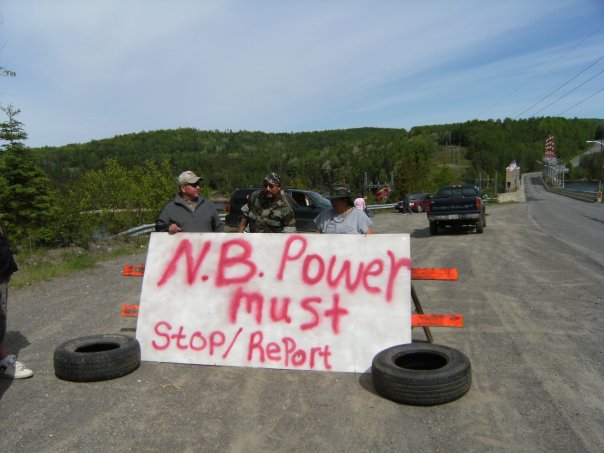
 This past June, the Tobique First Nation set up a roadblock on the highway leading to the Mactaquac hydro dam in south central New Brunswick., reviving a struggle for power–hydro power– that goes back to the mid 1800s. The Newly-founded N.B. Media Co-op reports.
“Pack Up and Get Out”
Why the Tobique First Nation took control of their territory’s hydro dam
TOBIQUE FIRST NATION – On the morning of Monday, June 8, 2009, a group of Maliseet community members walked peacefully into the hydro station. Stephen (Red Feather) Perley approached the New Brunswick Power Corporation (NB Power) employees and said, “You guys have fifteen minutes to pack up and get out.” The employees left, the community wrapped a chain around the gate and locked it. The dam was now the property of the Tobique First Nation.
Tobique, the largest Maliseet reserve in the province, first rejected a developer’s bid to build a hydro dam on their territory in 1844. They rejected another bid in 1895. At that time, the Tobique River was “part of what may well have been the greatest salmon river system in the world,” (along with the St John River and its other tributaries) with hundreds of thousands of fish swimming upstream to spawn each year. The abundant salmon defined the community’s way of life, providing food and employment – many worked as guides in the summer months.
By 1945, individual developers had given way to provincial and federal agencies and in 1950 New Brunswick’s Premier approved construction of a dam at Tobique without consulting the land’s owners. By the end of the year, construction had begun.
When Tobique’s chief learned of the plan, he wrote to Indian Affairs, demanding “suitable action to protect our rights. If the building cannot be stopped,” he wrote, “we demand compensation.” For this, he suggested “free electricity for all domestic uses business on the reservation.” This was never honoured – as soon as the community had power lines, they received power bills. The Band Council paid these bills for Elders and community members on social assistance.
Today, barely any wild salmon still make their way up the Tobique river. Tobique residents blame the high rates of cancer on the power lines over their reserve and the toxic chemicals dumped and sprayed on their land by NB Power. The dam has eroded the reserve’s riverbanks, leading to “trees being washed away and homes in danger of falling into the river”. Many of the edible and medicinal plants are gone – the islands they grew on are underwater. And ironically, Tobique residents are charged among the highest electricity rates in the province.
In the spring of 2008, Canada’s Department of Indian and Northern Affairs put Tobique’s finances under third party management; the Band Council was now around $20 million in debt. The new manager stopped paying the power bills of Elders and members on social assistance, and in April of 2008 these households began receiving bills for thousands of dollars.
Despite all of its troubles, Tobique remains a lush, picturesque locale, with many proud residents deeply devoted to their land and to each other. When NB Power threatened to cut off an Elder’s electricity, the community stepped in.
In May of 2008, a group of Tobique activists set up a blockade by the road into the reserve and denied NB Power access, first to the reserve and soon after that to the dam as well. Almost all band members stopped paying their power bills pending a negotiated agreement.
In July of 2008, the community began allowing NB Power access to the dam to do repairs and maintenance on the condition that NB Power employees check in with them first and that a band member escorts the employees into the dam or community.
That month, NB Power forgave over $200,000 worth of hydro bills, but they were not willing to negotiate a long-term arrangement to the community’s satisfaction. The women sat at the blockade every day until November, when New Brunswick’s no-disconnect policy comes into effect. The policy prevents NB Power from cutting off anyone’s electricity, which is all the more poignant since the 2008 death of Paul Durelle, a man in Baie-Ste-Anne, NB whose power was cut off by NB Power when he couldn’t pay his bills over the winter.
This spring, the struggle began again. In May of 2009, an NB Power employee was found on to the reserve reading meters. The community gathered and, on June 8th, took over the generating station. The blockade went back up, this time by the highway in front of the dam.
Tensions escalated on June 26, 2009, when a truck rolled by the blockade and into the station. When the blockaders caught up with it, the driver was talking on his cell phone. Stephen Perley told him to hang up. “You’re trespassing,” Perley said, “On behalf of Tobique First Nation, I’m seizing the truck.”
They escorted the flustered driver up to the blockade, where they gave him food and water. He phoned his employer to pick him up, but NB Power refused. The RCMP drove him home.
At the time of writing, negotiations continue. Maliseet women sit at the blockade every day playing cards and watching for NB Power trucks as the cars drive by, many honking in support. The dam continues to operate, NB Power continues to profit off of Tobique’s land, and the blockaders continue to allow workers in for maintenance and repairs.
The First Nation has made some gains: on June 30th, 2009, the provincial Minister of Aboriginal Affairs committed to funding the restoration of eroded riverbanks and the clean-up of toxic and other wastes dumped at and around the dam.
Additionally, Ottawa’s Department of Justice recently validated Tobique’s specific land claim, which will likely be the largest in Atlantic Canada, and negotiations are underway for compensation.
However, the dam and now a truck worth $170,000 are in the hands of the Tobique First Nation and they’re not giving them back without an equitable settlement. Key issues that must be addressed include compensation for damages and sharing benefits from the dam, including at least some amount of ongoing free electricity. Such a solution seems unlikely in the near future, and Tobique’s unpaid power bills now total over $800,000.
In the weeks and months to come, anyone concerned with Indigenous rights should keep a close eye on the province of New Brunswick.