
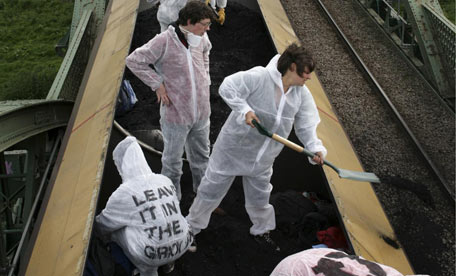
 News is being tweeted out of court – all defendants found guilty of obstruction of the train.
Judge has stated that he will be imposing community service type punishments and no prison time.
Defendants liable for costs and compensation.
The 22 were acquitted of actually stopping the train, after evidence that no one knew which of them had donned fake railwaymen’s uniforms and used red flags to bring it to a halt (2 ill & 5 earlier admitted guilt).
A defendant’s summing up (3rd July):
“Members of the jury.
I’m going to try to summarise why we feel that we are not guilty, why we feel that what we did was right, despite the very proper laws against obstructing trains, why we feel that it was the wrong decision of the Crown Prosecution Service to prosecute us in this case, and why we don’t feel that we are guilty of a crime.
I want to start by responding to your request for clarification yesterday about “lawful excuse”. His honour may say [in his summing up] that it’s true that there are ways in law to make space for circumstances, to allow a bigger picture to be considered.
These ways can have different names for different offences — so for example “lawful excuse”, which you asked about yesterday, applies only to the charge of criminal damage. For example, last September, a jury in Kent found six protesters not guilty of committing £30,000 worth of criminal damage to Kingsnorth coal-fired power station, since the group were acting to prevent a greater crime. Those on trial did not disagree that criminal damage is a crime, just that, in certain circumstances, it may be necessary and proportionate to cause some damage to prevent a great crime. That jury agreed.
His honour may explain that there is a legal defence of “necessity”, that applies to most laws, and that it was on the basis of “necessity” — the fact that we believed our actions were going to save lives and that we had to act — that we prepared a legal defence before this trial. Along with many legal professionals we were very disappointed by his honour’s decision prior to the trial that this defence was not available to us in law. Nonetheless we decided not to appeal against it. We felt that you the jury would be free to decide on the facts of a case as you find them – and not just the ones his honour tells you are relevant.
It’s up to you to decide whether what we did was necessary. I would like to emphasise to you that we believed and we still believe that it was urgently necessary to do what we did, and proportionate to the scale of the problem, that the consequences of that train taking coal into Drax are so serious that any reasonable person would understand our reasons for stopping it. To help explain why we were so sure of the links between Drax’s activities and deaths around the world we had expert witnesses lined up to talk to you about the immediate and ongoing harm that Drax’s emissions cause. However from what evidence we have been able to get across to you, with his honour’s indulgence, we hope that you can see that these facts speak for themselves, and our actions, though harmful, were indeed necessary to try to stop a greater harm. And if you agree with that then you still have a legal right – as the jury – to find us not guilty.
You’ve heard it said already I think, that the judge decides about the law, but the jury decide about the facts. What does that mean? It means you the jury can decide as you see fit. You the jury have a constitutional right to follow your own judgement and not necessarily follow the judge’s directions to find us guilty. In other words, you get to make the final decision. In law this principle is called the jury’s power of nullification, and it’s been a right that has been regularly used over the years when juries have felt the law has been applied harshly, or inappropriately, or unjustly, or incorrectly.
Perhaps I can explain this with a quote from a very senior judge, Lord Denning. He said:
“This principle was established as long ago as 1670 in a celebrated case of the Quakers, William Penn and William Mead. All that they had done was to preach in London on a Sunday afternoon. They were charged with causing an unlawful and tumultuous assembly there. The judge directed the jury to find the Quakers guilty, but they refused. The Jury said Penn was guilty of preaching, but not of unlawful assembly. The Judge refused to accept this verdict. He threatened them with all sorts of pains and punishments. He kept them ‘all night without meat, drink, fire, or other accommodation: they had not so much as a chamber pot, though desired’. They still refused to find the Quakers guilty of an unlawful assembly. He kept them another night and still they refused. He then commanded each to answer to his name and give his verdict separately. Each gave his verdict ‘Not Guilty’. For this the judge fined them 40 marks apiece and cast them into prison until it was paid. One of them Edward Bushell, thereupon brought his (case) before the Court of the King’s Bench. It was there held that no judge had any right to imprison a juryman for finding against his direction on a point of law; for the judge could never direct what the law was without knowing the facts, and of the facts the jury were the sole judge. The jury were thereupon set free.”
This was affirmed as recently as 2005, in relation to the case of Wang, where a committee of Law Lords in the highest court in the land, the House of Lords, concluded that: “there are no circumstances in which a judge is entitled to direct a jury to return a verdict of guilty”. So you do have that right to decide for yourselves. And unlike in 1670, his honour won’t be able to fine you, or put you in prison for making what he sees as the wrong decision.
There have been many cases over the years where juries have decided, on reflecting more broadly, to find people not guilty despite directions from the judge. For example, the case of Zelter and others who were accused of damage to an aircraft about to be used for bombing civilians. In all of these and others the judge said that the defendants admitted the offence and so must be found guilty. But the jury chose to look outside the limited view of the court room, and to find them not guilty.
The freedom that you have is what enables the law, where necessary, to move forward. It is what allows you to look beyond the confines of this court to the wider world, and to make a judgement based not just on law, but to make a judgement based on justice. Justice is the force that underpins and breathes life into the law, and it is your role as the jury to see that justice as you see it is done.
We all know that times change, and what was acceptable in one era may not be acceptable in another. You have heard of how it was once legal to own other people, how it was illegal for women to vote. Well one way or another we are going to have to stop burning coal and move on from the fossil fuel era. And that means that the law will eventually have to change and acknowledge the harm that carbon emissions do to all of us, by making them illegal. The only question is whether the law will catch up in time for there to be anything left to protect.
We are not trying to tell you how to decide. We are only trying to say that it is up to you, and we are grateful for that.
I want you to think back to that situation of there being a person on the tracks ahead of that train going on its way to Drax. Members of the Jury, it may sound like a strange thing to say but in truth there is a person on the branch line to Drax. The prosecution have not challenged the facts we presented to you on oath about the consequences of burning coal at Drax. 180 human lives lost every year, species lost forever. There is a direct, unequivocal, proven link between the emissions of carbon dioxide at this power station and the appalling consequences of climate change. That many of those consequences impact on the poor of other nations or people in Hull we don’t know and should not in any way negate the reality of this suffering. We got on that train to stop those emissions, because all other methods in our democracy were failing. Just because we don’t know the name of the person on the tracks or where they live or the exact time and day of their dying, does not in our view mean they are less worthy of protection.
We don’t dispute that there’s a law against obstructing trains. We don’t dispute that obstructing trains is a crime and should continue to be a crime. We just argue that in this case, we should not be found guilty of a crime for trying to block this train on its way to Drax.
On Tuesday the prosecution argued that what we did was quite simply a crime, and as a result we should be found guilty. They were trying to suggest that if you find us not guilty, the whole world would fall apart. We argue that the more likely route to the whole world falling apart is if we continue burning coal in the enormous quantities that it is being burnt at Drax.
His honour may say that we have been telling you stories, that we are trying to introduce emotions into the trial to distort the evidence. But we have been telling you the facts. If those facts move you, that’s because they are moving, and they are what moved us to do what we did.
We are happy to be judged by you, the jury.
Thank you for taking the time to listen to us.”