
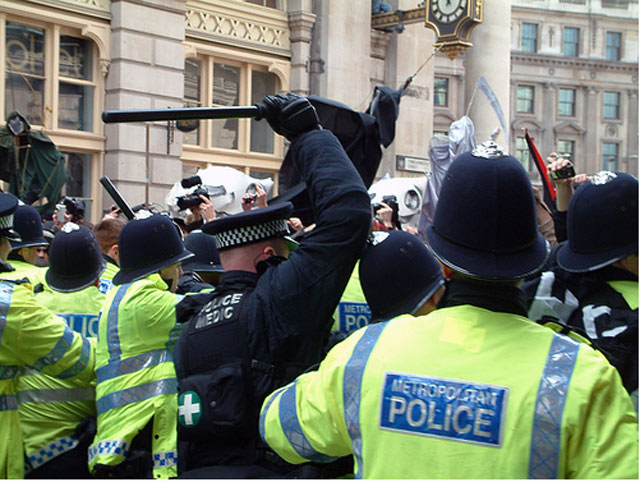
Channel 4 commentary on what happened to Ian Tomlinson just before his death – the latest ITN footage combined with the first footage published on the Guardian website. On the ground, protestors try to help before being cleared out of the area – counter the media-bottle-throwing hype, watch two eye witnesses.
New incident of systemic police violence – when an officer slaps the face then batons the legs of a woman – captured on film.
Even newer video evidence of yet more police violence – shields and fists used to punch without provocation – more details.
Newest footage which shows Ian Tomlinson’s head hit the ground from the push by police.
Police charge press photographers.
Collections of videos of police violence: 1 | 2
—————-
London assembly and procession:
Easter rising!
Reclaim the City, Saturday April 11
* 12.00 noon Saturday – 12.00 noon Sunday
* Wear Black
* Assemble 11:30am, Bethnal Green
* Lay your flowers where Ian Tomlinson died
* Bring pop-up tents to stay with Ian through the night
—————-
Edinburgh protest:
Four months ago it was a 15-year-old schoolboy in Greece – today it’s a 47-year-old newspaper seller in the UK.
Enough with the state murders!
Whether civilians’ deaths are caused because of “heart attacks” (most likely due to police terror) or head injuries (due to police brutality) or “misfires” (due to police stupidity), we say we had Enough!
Enough! Of your lies in attempting to cover up your mistakes
Enough! Of your “Robocop” attitude
Enough! Of your “to serve and protect” fake masks
Enough! Of you being the guardian dogs of the privileged elite
We say Enough! and we are going to say it out loud so everyone can hear us.
Saturday 11th of April at 1:30pm in Bristo Square (Edinburgh)
Bring friends, banners, candles and something to make noise with (drums, whistles etc.)
—————-
Redditch protest:
The policing at the G20 protests was extremely violent and aggressive. Peaceful protesters were attacked and beaten, many of them suffering injuries. We’ve all seen the videos of police laying into the climate campers who stood there with their hands in the air calmly stating “this is not a riot”. And now we see film evidence that Ian Tomlinson, who was not even a protester, was brutally attacked from behind with a baton, before being shoved hard to the ground by a vicious cop. Ian Tomlinson died minutes later – I call this MURDER and it happened on Jacqui Smith`s watch!!
This is a call out for a National Demonstration in Redditch, the constituency of Jacqui Smith, the Home Secretary.
Demonstrate against the increasingly violent and aggressive policing at peaceful protests. Demonstrate against the erosion of civil liberties in our so called democracy. Demand that Jacqui Smith ensures that the officers who murdered Ian Tomlinson are brought to justice.
Let`s see how Jacqui Smith likes it when 1,000s of protesters turn up in her home town demanding JUSTICE!!!
Saturday 18th April – 12 noon outside Redditch Town Hall.
The town hall is about 10 minutes walk from the train station.
http://www.multimap.com/s/QKjPxY9S
—————-
A protest against the death of Ian Tomlinson and the growing use of violent tactics by police against protesters will take place 1 pm Saturday 11 April, Grey’s Monument, Newcastle
—————-
Legal call-out
G20 LEGAL UPDATE
First, thank you for all the emails. We are reading them but not acknowledging them at the moment due to the quantity. Our apologies. For the time being, if you would like us to respond – please send us another email requesting a response.
HOW THE POST-PROTEST LEGAL PROCESS WORKS:
Lots of people are writing to us with evidence of police misbehaviour and there certainly seems to be grounds for complaint in many of them.
However, crucially complaints and legal claims need to be brought by individuals: we can’t do it on your behalf. Also, do NOT make a complaint if there’s a possibility that you will make a legal claim, or could support someone else doing so – complaining to the IPCC before suing the police will compromise the case.
What we are doing is:
1. We are making sure we have the evidence available to us sorted so we can locate supporting evidence for those arrested or those who bring complaints of assault and so forth against the police.
2. We are exploring whether there is a legal challenge strategically worth bringing this time. If so, we will be looking for potential litigants.
3. We are preparing report and film on the Camp and may be in contact with some of you to use your statements. We have made no decision as to what we will do with the report at this point.
4. We have a particular interest in how those with injuries or illnesses were treated by the police – so if you have relevant evidence there please let us know. Depending on the evidence, we may focus on this as an area of concern.
What you could do:
If you were wrongfully arrested, or assaulted and injured by a police officer, you may be able to bring a case against the police. Please contact Bindmans Solicitors in the first instance: 020 7833 4433. If they do not have the capacity then we can recommend other firms of solicitors who have worked with activists in the past. We may have supporting evidence so let us know if we can help. Please keep us informed of the outcomes – legal@climatecamp.org.uk.
If you were arrested and charged, let us know as we may have supporting evidence that may help with your defence. You will need to give your solicitor your consent to them talking to us or they will not be able to tell us about your case. Please keep us informed of the outcome – legal@climatecamp.org.uk.
N.B. If you have previously left any important legal information on an answering machine or sent to a different email address and nobody got back to you, please try again using the email address above
Meanwhile write up anything relevant now and email us, let us know if you have footage and we will send you some information on how to share it with us, keep copies of any original notes, photos and film (and keep them for 12 months).
Finally, if your witness statement relates to the G20 Meltdown protests at Bank, there is a separate legal support process. Please contact the Legal Defence and Monitoring Group – email ldmgmail@yahoo.co.uk or post to Legal Defence and Monitoring Group, BM Box HAVEN, London, WC1N 3XX .
—————-
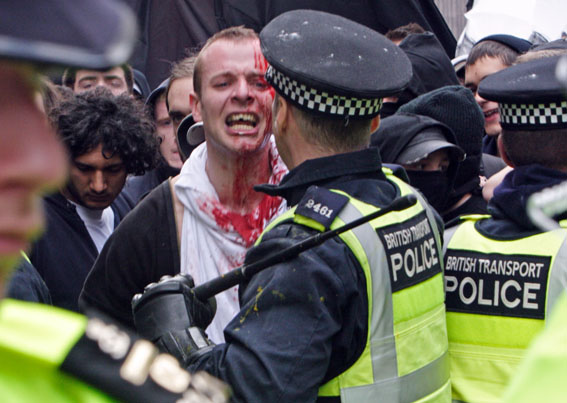
Public Order strategies to not get kettled and beaten by the police
For how to survive police tactics in big public order situations such as the G20 protests, and still do what you want to do, read the Guide to Public Order Situations – any comments or ideas please send them in to manchester@earthfirst.org.uk
—-
Video of police rush on climate camp – why you should read the above, rather than listen to someone on a megaphone suggesting people put their hands up AND link arms! The same charge but clearer and more brutal can be seen here. Other clips and reports from the day are all here.
—————-
Journalists removed from covering G20 protests with illegal use of laws and through injury – see the commentaryhere.
—————-
Beautiful & inciteful G20 photo essay – chapter 1: the anarchists are coming! | chapter 2 part 1: storm the banks? | chapter 2 part 2: a tale of kettles, and death | chapter 3: police work
—————-
Correcting the media narrative of the G20 protests on April 1, 2009
The media coverage of the G20 protests has been systematically biased, writes Musab Younis – ignoring the violent policing, the tactic of open-air imprisonment of demonstrators, and the real chronology of events. “It has taken remarkable obedience by the press,” writes Musab, “to refuse to ask some simple and obvious questions.”
#1 – The reversal of events
“Anti-capitalist protesters embarked upon a wrecking spree within a City branch of the Royal Bank of Scotland today,” shrieked The Times on April 1, “and engaged in running battles with police as G20 demonstrations turned violent. Police were forced to use dogs, horses and truncheons to control a crowd of up to 5,000 people who marched on the Bank of England, in Threadneedle Street, on the eve of the London summit.”
This narrative of events is entirely typical. Under the headline “Police clash with G20 protestors”, the BBC reported that “protesters stormed a London office of the Royal Bank of Scotland”, later adding tha: “officers later used ‘containment’ then ‘controlled dispersal’” (BBC, April 1). The Guardian reported: “The G20 protests in central London turned violent today ahead of tomorrow’s summit, with a band of demonstrators close to the Bank of England storming a Royal Bank of Scotland branch … [S]ome bloody skirmishes broke out as police tried to keep thousands of people in containment pens” (The Guardian, April 1).
What is interesting about this narrative is that it precisely reverses the events of the day.
Eyewitness accounts of the day agree that the police began the now-infamous tactic of ‘kettling’ protestors – refusing to allow anyone in or out of a confined space held by police lines – as soon as the four marches had converged on the Bank of England, at around midday. An article in The Times a day earlier by a former Assistant Commissioner of the Metropolitan Police, Andy Hayman, suggested that the police had planned to use this tactic well in advance: “Tactics to herd the crowd into a pen, known as ‘the kettle’, have been criticised heavily before, yet the police will not want groups splintering away from the main crowd. This would stretch their resources” (The Times, March 31).
Note that the “violent outburst” (Telegraph) of window-breaking took place hours after the police had decided to “herd the crowd” of at least 5,000 people “into a pen” without access to food, water or toilet facilities – and without allowing them to leave.
The press was surely aware of this. The Guardian’s live blog from the day noted at 11.57 a.m. that “the barriers designed to fence in the protesters are not big enough”, an hour later it confirms that there is “a ‘kettle’ at the Bank of England”: half an hour later they report “clashes” and finally, at 1.30 p.m., “a window has been smashed.” An objective observer of the sequence of events here might ask whether the police ‘kettle’ had in fact been responsible for the “clashes”, “violence” and smashed window.
But this idea – that the kettle might have provoked the “clashes”, and that the police might therefore be responsible for the “violence” – is remarkably absent from virtually all of the reams of press coverage of the protests. We do, of course, have a spectrum of opinion: whereas the right-wing Daily Mail sees the protestors as “a fearsome group of thugs”, a “bizarre group of misfits” fuelled by “Dutch courage” and a “willingness to use violence” (April 1), for the left-wing Guardian only “a minority of demonstrators seemed determined to cause damage” whilst “much of the protesting” was “peaceful” (April 1).
Again, the notion that there was not a “violent” core of demonstrators at all, but that people were provoked into “clashes” with the police due to police tactics, is absent. Even the article which is by far most critical of the police actions – a piece by Duncan Campbell in The Guardian titled ‘Did police containment cause more trouble than it prevented?’ – only goes as far as to say: “As for the violent clashes that led to cracked heads and limbs, how much was inevitable and how much avoidable?”. Campbell concedes that “some demonstrators were bent on aggro” but adds: “so were some of the officers.” He also criticises the conditions inside the kettle and suggests that it will make people think twice before embarking on a demonstration in future. Thus Campbell suggests the “clashes” were avoidable, but does not indicate that the kettles actually led to the “clashes” – though, to give credit where it is due, his is the only piece in the press which dares to suggest that the police were themselves violent.
#2 – Justifications
Well before the protests, the press had been reporting with glee the “violence” predicted as “London went into lockdown” and “protestors issued a call to arms” with “police fears” of protestors “intent on violence” (The London Paper, 31 March).
The BBC posted a sympathetic article titled ‘The challenge of policing the G20’ (30 March) which pointed out that: “police officers spend their professional lives trying to play down the public order implications of demonstrations – it’s in their interests to keep things calm.”
“The security strategy of the day,” they reported breathlessly, “resembles a three-dimensional ever-changing puzzle” where “the unknowable factor is the demonstrator bent on violence”. The article ended with a quote from Commander O’Brien: “If anyone wants to come to London to engage in crime or disorder, they will be met with a swift and efficient policing response.”
This flurry of media coverage predicting “violence” from “anarchists” was clearly initiated by the police, who released a barrage of press statements before the protests which served to pre-emptively quell criticism of their actions on the day – actions which had, of course, been planned well in advance. The G20 policing was to be “one of the largest, one of the most challenging, and one of the most complicated operations” ever “delivered” by the Metropolitan Police, according to Commander Simon O’Brien, who hit the press circuit with gusto in the days preceding the G20.
The press obediently played their part by reporting police “fears” word for word, with complete sympathy, and with no question on asking those who planned to protest whether they thought the police reaction might be overly violent. After all, “the police have had to prepare for every possibility” on April 1, noted the Times: “from terrorism to riots” (The Times, March 31).
With ample opportunity to question an unusually talkative police force, barely a single sentence in the press asked whether the police preparation for the protests might be heavy-handed or that a violent reaction by the police to the protests might lead to serious injury or death. The protestors, of course, were to be “violent” “mobs” (based on police “intelligence” gleaned from “social networking sites”), but the police were to be calm, measured and undertake only necessary measures.
The effect of this press coverage was to justify in advance all police actions whilst de-legitimising any actions by protestors. Endless predictions of “violent protestors” meant that all the day’s “clashes” were sure to be blamed on the “minority” of “intent on violence” – even if evidence suggested that “clashes” were actually instigated by police, and that violence was in the main inflicted by the police on protestors. Within the press narrative, the police are merely reactive; forced to respond to a “violent” situation and “keep things calm”; the notion that they could have actively encouraged and provoked “clashes” seems patently absurd.
#3 – So what’s missing?
There are a number of important questions which simply didn’t appear in the press.
a) Did the police intend to ‘kettle’ demonstrators in a confined space regardless of whether there was any violence or not?
All the evidence, including past cases of the police using this tactic, suggests this was the case. (At the Climate Camp protest at Bishopsgate on the same day, the police beat protestors back into a kettle despite them holding up their hands and chanting ‘this is not a riot’, as can clearly be seen on the Indymedia video ‘Riot police attack peaceful protestors at G20 climate camp’).
Is there a possibility that the police were not in fact “forced to use dogs, hoses and truncheons” due to “violent” protestors, but that they inflicted violence on peaceful protestors?
b) Was there really “violence” from the protestors?
The Metropolitan Police state that “small groups of protestors intent on violence, mixed with the crowds of lawful demonstrators” (Met Police, 2 April) and The Guardian quotes Commander Simon O’Brien as claiming there were “small pockets of criminals” within the crowd who attended a memorial for Ian Tomlinson on April 2. Again, eyewitness accounts of both days state that virtually all of the violence came from police. Despite hours of kettling and media reports of “missiles” being thrown at police (translation: plastic bottles), the only tangible evidence of protestor violence at either of the two main protest sites seems to have been some smashed windows, which of course is damage to property and not “violence”.
The Guardian reports that a small group of demonstrators were “seeking confrontation as they surged towards police lines.” Of course you’re expected to sit quietly when you are being held against your will behind police lines and periodically beaten with batons. But is it conceivable that those who “charged” police lines simply wanted to leave? And why is it confrontational to “charge police lines” without using any weapons, but not confrontational to hold thousands of people in an area, keeping them there with kicks and batons? That the protestors could have actually showed remarkable restraint when being provoked in an unbearable situation is laughable according to all the press. Yet this is what eyewitness accounts point to. Only the Letters page in the Guardian gives any credence to this: one person writes that “the few scuffles we did witness were caused precisely at the frustration of people not being allowed to come and go as they pleased”; another states that: “an ugly mood developed after those who had come to exercise their democratic right to protest were detained against their will” (Guardian, April 3).
c) Were the police tactics responsible for the “violence” of the day?
Because the press has been admirably obedient in reversing the course of events, this is an impossible question – according to the media first there was “violence” from “anarchist” protestors, then the kettle began. Yet once we establish a more accurate chronology, and take into account police prior planning, it seems that it had always been intended to shut thousands of people into an enclosed space without being able to leave.
d) Was the ‘kettling’ tactic intended to make people think twice about demonstrating in future?
The most critical piece in the press, by Duncan Campbell in the Guardian, states that those “people thinking about embarking on demonstrations in the future may have to decide whether they want to be effectively locked up for eight hours without food or water and, when leaving, to be photographed and identified.” Yet it does not suggest that this may have been the initial intention of the police in adopting this tactic, even though it is absurd to suggest the police might have planned to use this tactic without imagining it would lead to anger and frustration on the part of those trapped in the kettle. In conjunction with the extensive restrictions to freedom of protest under the New Labour government, amply documented elsewhere, it might be reasonable to suggest that the police tactics were in part, at least, designed to deter protestors.
e) Were the police violent and should any officers face charges?
Remarkably, this question is absent from virtually all the press coverage – despite hundreds of injuries to protestors, the death of someone apparently trapped in a kettle, and video footage showing baton charges directed towards crowds of people with their hands in the air, the use of riot shields as an offensive weapon, and the beating with batons of protestors sat on the ground (see, for example, ‘Riot police attack peaceful protestors at G20 climate camp’ on Indymedia). The ample groundwork laid by the police suggesting there would be protestors “intent on violence” happily accounts for all the violence of the day and makes easy to ignore eyewitness accounts that state that peaceful protestors being kettled, charged, beaten and provoked by the police. Given the number of witnesses and video evidence, it has taken remarkable obedience by the press to refuse to ask this question – and for a media so obsessed with violence, it seems strange that the overwhelming violence of the day, that inflicted by the police on protestors, barely merits a mention.