
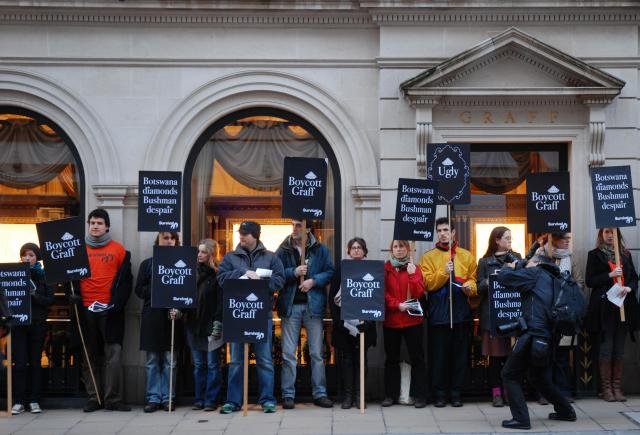
 Survival’s campaign targeting Graff Diamonds over its involvement in a diamond mine planned on the land of Kalahari Bushmen in Botswana has stepped up a gear. Thirty protesters gathered on the 11.2.09 outside Graff’s flagship London store holding placards saying ‘Boycott Graff’ and ‘Botswana diamonds: Bushmen despair’.
The store is based in the fashion epicentre of London surrounded by shops from Yves San Lauren, Chanel etc. The diamond industries main product is high image and thus has shown itself to be sometimes more susceptible to pressure than other resource sectors such as mining and oil. Previous pickets by Survival International and public shaming of fashion houses and top models resulted in De Beers pulling out of the planned diamond mining in the Kalahari.
There are 100,000 Bushmen in Botswana, Namibia, South Africa and Angola. They are the indigenous people of southern Africa, and have lived there for tens of thousands of years.
In the middle of Botswana lies the Central Kalahari Game Reserve, a reserve created both to protect the traditional territory of the 5,000 Gana, Gwi and Tsila Bushmen (and their neighbours the Bakgalagadi), and the wildlife and ecosystem of which are a part.
In the early 1980s, diamonds were discovered in the reserve. Soon after, government ministers went into the reserve to tell the Bushmen living there that they would have to leave because of the diamond finds.
In three big clearances, in 1997, 2002 and 2005, virtually all the Bushmen were forced out. Their homes were dismantled, their school and health post were closed, their water supply was destroyed and the people were threatened and trucked away.
They now live in resettlement camps outside the reserve. Rarely able to hunt, and arrested and beaten when they do, they are dependent on government handouts. They are now gripped by alcoholism, boredom, depression, and illnesses such as TB and HIV/AIDS.
Unless they can return to their ancestral lands, their unique societies and way of life will be destroyed, and many of them will die.
Although the Bushmen won the right in court to go back to their lands in 2006, the government has done everything it can to make their return impossible. It has:
Banned them from using their water borehole,
Refused to issue a single permit to hunt on their land (despite Botswana’s High Court ruling in December that its refusal to issue permits was unlawful),
Arrested more than 50 Bushmen for hunting to feed their families,
Banned them from taking their small herds of goats back to the reserve.
Its policy is clearly to intimidate and frighten the Bushmen into staying in the resettlement camps, and making the lives of those who have gone back to their ancestral land impossible.
More information on the Kalahari Bushmen can be found on their own website : www.iwant2gohome.org or the website of Survival International (which is updated more often): www.survival-international.org/tribes/bushmen