
Nature for people – not for business!
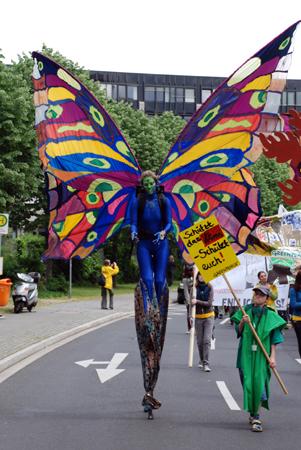
The 4th Meeting of Parties to the Cartagena Protocol on Biosafety (MOP 4) and the 9th Conference of the Parties (COP 9) to the Convention on Biological Diversity (CBD) are taking place in Bonn from the 12th to 30th May.
Behind the disguise of nature protection, transnational companies use these negotiations to increase their control over natural resources. Many of the solutions they push for to tackle climate change and the loss of biodiversity (agrofuel, GM crops and trees, Terminator, protected areas,…) in fact lead to the privatisation of biodiversity, at the expense of rural and indigenous communities.
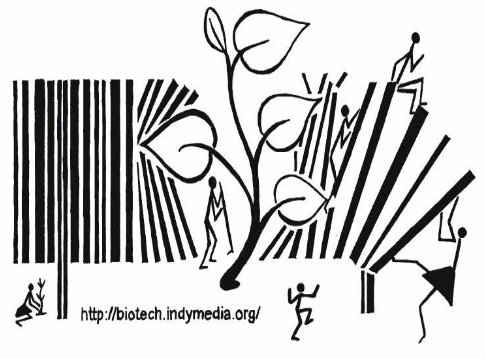
A coalition of social movements and activists’ networks calls to protests under the motto “Nature for people, not for business!” We believe that in front of massive environmental destruction resulting from the plundering of resources by corporate interests, the priorities are an immediate end to privatisation and a fair distribution of natural resources in the benefit of local communities.
Join the mobilisations, resistance is fertile!
More info at ASEED and Biotech Indymedia
——————
Protest reports:
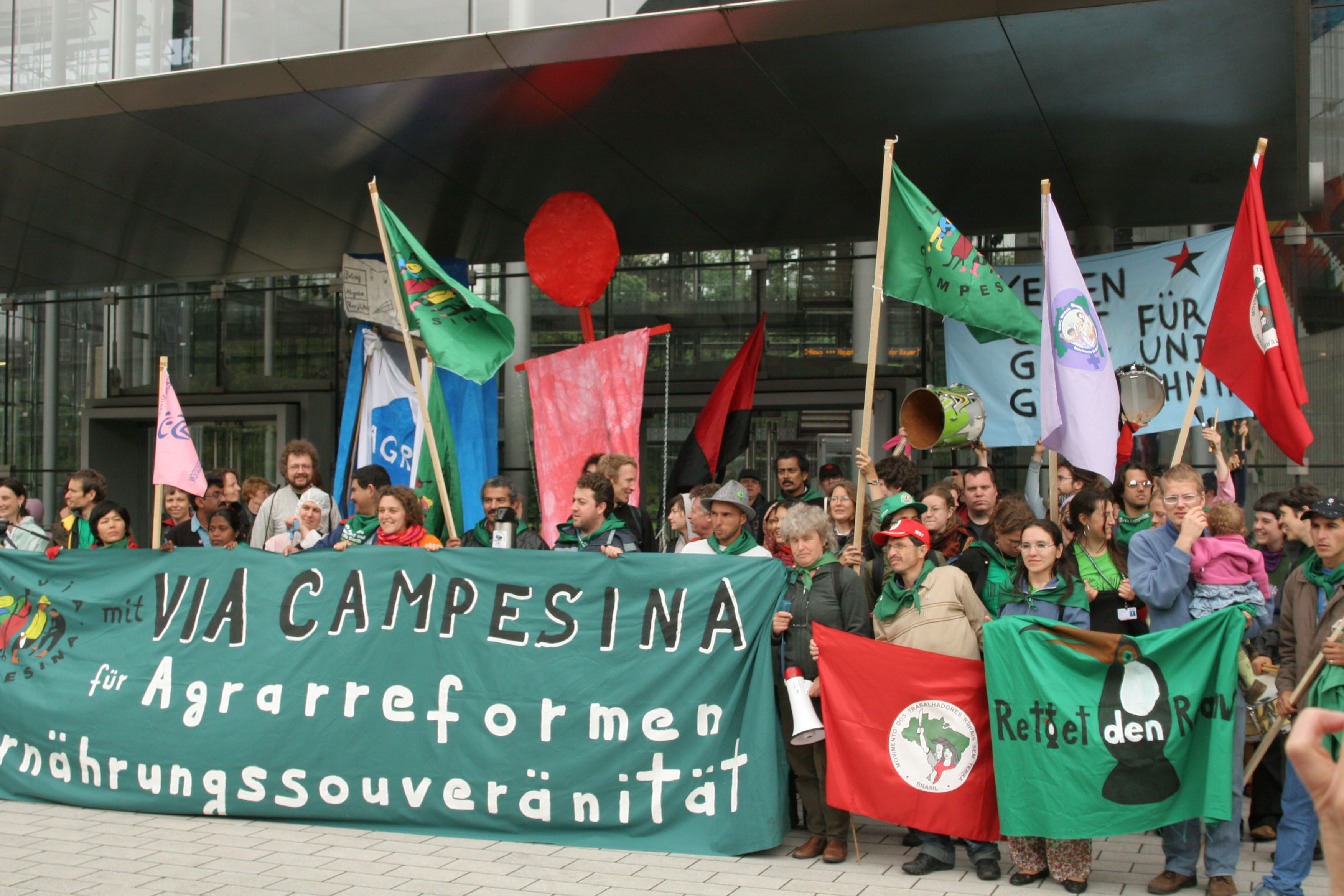
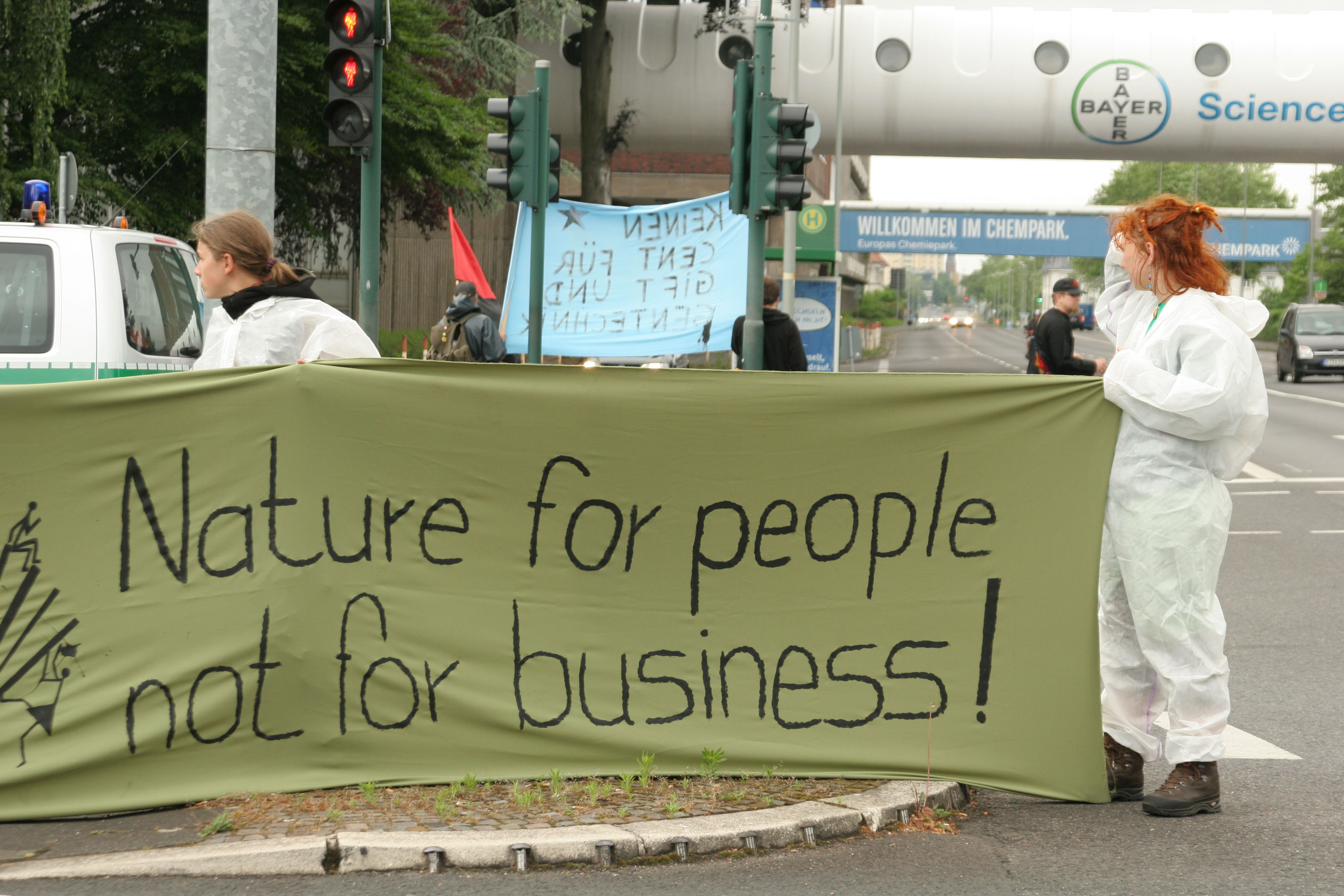
About 100 people protested outside Bayer on 17th May & delivered this –
Open letter to the Bayer Corporation in Leverkusen
Bonn, 16 May 2008
Dear Board of Directors of the Bayer Corporation,
Dear Bayer Employees,
During international conferences the Bayer Corporation attempts to exert enormous influence upon both, the process of negotiations as well as the results. This is now the case during the Convention of the Parties of the UN Convention on Biological Diversity (COP 9), as well as the negotiations of the Biosafety Protocol (MOP 4), taking place in Bonn. Thus, your company strives to maintain a “green” image, as indicated by the fact that your company was a sponsor of the United Nations Environment Programme (UNEP) last year.
However, this is nothing more than a “greenwashing” campaign, since in other instances your lobbyists are taking every effort to fight attempts to protect nature—from the Kyoto Protocol, to the prohibition of CFCs to the new EU laws on chemicals known as REACH.
In addition, Bayer is a producer of many highly dangerous products; it emits large quantities of dangerous gases and greenhouse gases; it promotes the planting of genetically modified products and thus belongs to one of the large destroyers of biological diversity.
to name but a few examples:
Bayer is responsible for the insidious poisoning of soils and sources of water; it is responsible for the eradication of useful plant and animal varieties, an increase of pesticide-resistant pests and the massive damage of ecological valance through agrochemicals. Pesticides are known to be a main cause of the loss of plant and animal varieties. The UN Food and Agriculture Organization (FAO) has termed this “an environmental tragedy”. Bayer is the second largest producer of pesticides and is a world leader in the production of highly poisonous insecticides. According to the World Health Organization (WHO), several million people currently suffer from the effects of pesticide poisoning every year. Of these, up to 200,000 result in deaths.
One of the most recent cases concerning dangerous chemicals took place in the US Bayer factory in Institute, West Virginia. On December 28, 2007, several vats containing Thiodicarb, a pesticide, exploded. Dozens of citizens had to be treated for headaches and breathing problems, including at least one person who had to be hospitalized. Thiodicarb is one amongst the most dangerous agricultural chemicals that exist. It has been banned in Europe and during the past year there were 154 organizations in 35 countries which demanded from the Bayer Corporation to stop the sale of pesticides catalogued as being among the most dangerous, including Thiodicarb. The same factory in West Virginia contained extremely poisonous substances, including Phosgen, MIC and Phosgen gas, the latter of which was used as a weapon during the First World War.
Nature, consumers and users are also threatened by the Bayer-made herbicide, Glufosinat. According to a report by Swedish authorities which was based on research by the European Food Safety Authority, Sweden asked that Glufosinat be banned. Almost all genetically-modified plants made by Bayer are resistant against Glufosinat. The Genetic manipulation of plants is not aimed at fighting hunger, as is often claimed by Bayer. It is aimed at securing a market for herbicides. For ecological reasons, continuing the sale of Glufosinat can no longer be justified.
Bayer is responsible for the massive endangerment of biological diversity and the environment through the use of genetically modified plants. The company belongs to one of the most important protagonists of “green” genetic technology. Currently we are threatened with the likelihood of the EU approval of a variety of rice produced by Bayer—the same variety which was the center of the largest scandal concerning genetic technology to date, as rice which had not been approved for consumption reached trading markets worldwide. The massive planting of genetically-modified seed would inevitably be responsible for contamination and displacement of traditional rice varieties. Thus, biological diversity among crops would be harmed and the long-term food security would be threatened.
Other examples include the contamination of canola seeds through genetically-modified canola, which are illegal in Germany. This kind of pollution can be traced back to a herbicide-resistant product from Bayer CropScience which was tested many times in the field.
But Bayer refuses to take legal responsibility for the damages. This example goes to show once again that coexistence without the contamination of native seed varieties is impossible. Nevertheless, Bayer pushes forward to capture new markets: genetically modified canola is to be planted in Australia. Bayer has also requested permission for importing genetically-modified rice and canola.
Bayer is responsible for the privatization and monopolization of genetic resources such as seeds and medicinal plants. Bayer belongs to the largest transnational companies in the area of pharmaceuticals and agrochemicals which share the largest portion of patents granted to date. The attempts to monopolize them harm biological diversity in the fields and rob indigenous communities of their medicinal plants and traditional knowledge.
Years of intensive influence on lawmaking on the part of transnational companies resulted in the TRIPS (Trade Related Aspects of Intellectual Property Rights) agreement of the WTO. This agreement results in the legal commitment to intellectual property rights such as patents on biological and genetic material – that is, property rights on life. Bayer was involved in this.
A particularly insidious mechanism of control and power is so-called terminator technology, officially known as Genetic Use Restriction Technology. This technology results in sterility of plants after their harvest, such that they may not be reused for re-planting.
A moratorium was placed on terminator technology in 2000 as part of the Convention on Biological Diversity, since it represented too great a risk to biological diversity. The Bayer corporation is also involved in the development of terminator technology—as is attested to by circa one-half dozen patent applications with titles such as “New Gene for the Coordination of Cell-Ablation” or “Process for the Production of Sterile Female Plants”.
According to Bayer CropScience, however, the corporation only owns terminator patents as a result of its acquisition of Aventis Cropscience. This is a false statement. Bayer is owner of at least five patents on seed sterilization technologies. This suggests that Bayer continues to be interested in research and use of terminator technology. During the 2006 COP 6 meetings in Curitiba, Brazil, Bayer lobbyists were involved in trying to reverse the moratorium of these technologies.
Bayer is also involved in the development of pharmaceutical plants, thus threatening biological diversity.
A new development concerns large Agricultural Companies’ application for hundreds on few patents on plants that are genetically modified to withstand droughts and other climactic stress factors. This is part of the struggle to compete a lucrative market that is growing due to global warming. The Bayer Corporation is a participant in this process.
Bayer is responsible for the warming of the earth. Presently, the Bayer factory in Krefeld is involved in the building plan of a giant coal-burning power plant which would be expected to release 4.4 million tons of carbon dioxide and 4,000 tons of nitrogen oxide into the air each year.
Bayer is responsible for water contamination with 700 tons of phosphorous, 2,700 tons of nitrogen, 1.5 million tons of inorganic salts, 73 tons of organic chlorine and 28 tons of heavy metals. Bayer belongs to the ten largest water polluters in Germany. In addition one must consider Bayer’s enormous use of water, amounting to 2 million cubic meters daily. The Bayer factory in Leverkusen has a higher consumption of water as the neighboring city of Cologne, with roughly one million inhabitants.
Bayer is responsible for the planting of energy plants for Agrofuels, which compete with food crops. Bayer plans to produce agrofuels from canola oil as well as the tropical plant, Jatropa. In order to do so, it will rely on vast monoculture plantations as well as the heavy use of fertilizers and pesticides. The massive plantations of Jatropa will be responsible for the devastation of natural landscapes and the displacement of small farmers, as well as of a higher number of deaths through hunger. In India, landless people were already displaced from land which was purportedly “fallow”. This is the same land on which Bayer is planning to produce energy plants for agrofuels.
Bayer is also responsible for the death of millions of honeybee colonies in southern Germany, as suggested by the news of the last few days. The sudden death of honeybees happened immediately following the planting of corn. Many of the corn seeds were coated with a neurotoxin, Clothianidin, of Bayer CropScience. Beekeepers suspect that this could be responsible for the death of the bees. The Association of Beekeepers reports that this is the worst case of the death of honeybees of the past 30 years. Vicepresident of the Association, Manfred Raff justifies his suspicion of the Bayer neurotoxin based on the experience of Italian beekeepers, since planting in Italy happened several weeks earlier. In the latter case, Clothianidin was found in the dead bees. According to the Association, it is part of the agrotoxin Poncho Pro which is used for the etching of corn seed.
Bayer is responsible for hunger on the planet. While riots have erupted worldwide as a result of hunger, Bayer corporation states in its latest annual report, “we have been able to participate in the positive development of the world agrarian market”. This is a cynical formulation in the face of the drastic growth in prices of basic food products and the rise of hunger across the globe. The World Food Council considers that a substantial cause of the current food crisis can be traced back to a reduction in harvests caused by agricultural land that has been damaged by agrochemicals. As the second largest producer of pesticides, Bayer is significantly responsible for this development.
On the occasion of the negotiation of the Biosafety Protocol (MOP 4) from the 12.-19. of May in Bonn and considering the fact that liability in cases of genetic contamination are being discussed there, Bayer CropScience —together with Monsanto, Syngenta, BASF, DowAgroSciences and Dupont/Pioneer have proposed what they term a “compact”. They claim that they are willing to pay reparations in cases in which their products are responsible for the damage of biological diversity.
On the face of the matter, this seems positive. However, their compact pertains only to damage to biological diversity and human health. The environment as a whole or socioeconomic or cultural damages are not considered.
According to the proposal, damages to biological diversity are only to be considered if enough documentation on this biological diversity exists. However, no country holds such extensive documentation on biodiversity in order to be able to fulfill the requirements as have been presented. Therefore, the promises to make reparations remain empty! Moreover, contamination through genetic material has been said explicitly not to count as damage.
In addition, only states may be plaintiffs in these cases, such that individuals who have been caused damages remain without the possibility of receiving reparations. All legal procedures are to take place privately, leaving no transparency in the compact as proposed.
What is thus presented as a step towards corporate responsibility is an adept strategy of the company in order to protect itself against many instances of liability.
We highly criticize, therefore, that German as well as European policies continuously provide a platform for Bayer to carry out its “greenwashing program”, thus greatly supporting the interests of industries despite losses suffered by populations, biological diversity and the environment.
Worldwide, many individuals and organizations are resisting the health and environmentally damaging policies of the politics of the Bayer Corporation. We declare ourselves in solidarity with them and demand that the Bayer corporation end its deadly and poisonous production.
We demand that Bayer end immediately its environmentally harmful business, that it stop destroying biological diversity, and that it stop its privatization and monopolization. We demand that it take responsibility for its current actions and that it accept responsibility for any damages that may follow from these actions hereafter. As long as the corporation does not realign its practices, its claims to contribute to the conservation of nature ring both hollow and menacing.
Bayer—hands off from biological diversity
Hands off from ‘nature protection’ driven by profits and power.
For ecological agriculture and forestry, free of genetic technology and pesticides!
For the end to patents and intellectual property rights on life!
For the free access to seeds worldwide!
For a final prohibition of terminator-technology and any similar technologies causing sterilization!
Nature for people—not for business!
Signatories:
Aktionsnetzwerk globale Landwirtschaft, BUKO-Kampagne gegen Biopiraterie, La Via
Campesina, Coordination gegen BAYER-Gefahren, Bonner AK gegen Gentechnologie,
Aktionsbündnis COP 9, Verein fair-fish e.V., Indienhilfe e.V., Rettet den Regenwald e. V.,
Arbeitskreis Eine Welt Buchloe e.V., autofrei leben! e.V.
======
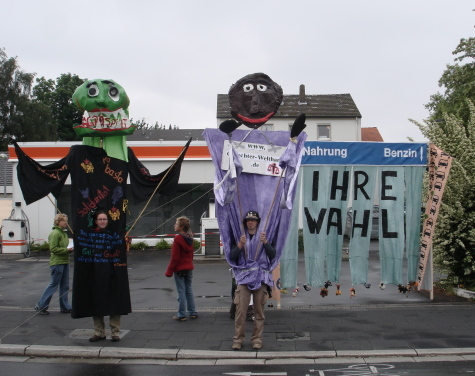
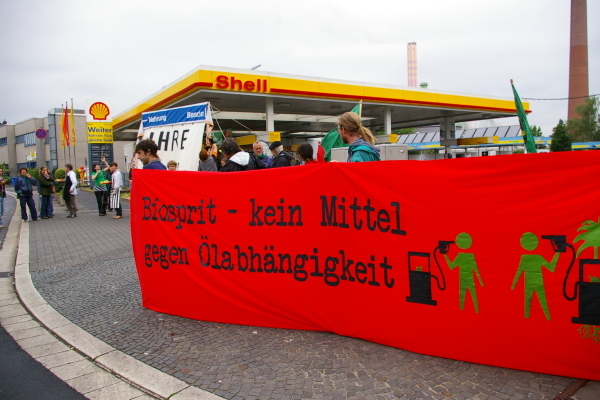
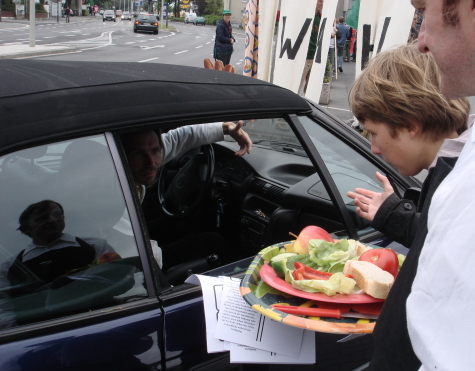
Bonn, Sunday May 18 – Around 60 people have been protesting in Bonn against the large scale production of agrofuels. At two petrol stations car drivers had to make a choice: ‘petrol’ to the right, ‘food’ to the left. Banners were stating “agrofuels, no solution for oil addiction.”
Nowadays the media are frequently reporting about the negative impacts of the use of crops for energy production. But so far the honest conclusion that we have to change our lifestyle and overconsumption of resources and energy is ignored by the same media and policy makers. In global capitalism a small minority exploits 80 per cent of the global resources.
Most drivers had some sympathy for the action but wanted to fill up petrol anyway this time. They had to for example to go to a football match. What can you do?
The worker in the Shell station was furious about the counter information in front of her petrol station and called the police. After some discussions the action was allowed, although drivers had to be given more possibilities to go around the ‘gate of choice’.
At the BFT station everything stayed very relaxed.
Amongst the activists were many people from Via Campesina, the international network of small farmers. For them and the millions they represent, the large scale introduction of agrofuels is a direct danger for their livelihood and life. You can read more arguments against the overconsumption of energy and agrofuels in the text of the brochure that has been distributed to the passers-by.
After two hours the group started to move again for a short demonstration ending on a field with a picnic with healthy and local food, as it is still possible.
—
Flier text:
Agrofuels are no solution for the climate and energy problem!
Action against biofuel and high energy consumption!
Food – Petrol
Hereby we want to draw your attention to the problems and consequences of the introduction of agrofuels. The cultivation of biofuels forms a direct competiton to food production.
You, as a driver, have to choose between food or petrol, as there is only 1,8 ha agricultural land available for each human being on earth.
You have the choice between:
a) Petrol: You tank but you get a negativ voucher which states how much less food you can consume the coming days.
b) Food: You receive something to eat and your car leaves without petrol.
The reason for the action
This week COP 9 is taking place in Bonn. The participants will debate on issues related to biodiversity and genetic resources. It concerns marine biodiversity, agrofuels, genetically motified plants, protected areas and the rights of indigenous people. However, biodiversity is also related to agriculture: ernormous areas are taken over by agricultural land, and large scale agriculture, as well as genetically modified monocultural plantations, are increasing. This is practically the opposite of biodiversity.
The situation regarding agrofuels in Gemany and the EU
In Germany regular petrol is currently mixed with 3 % Biodiesel / Bioethanol. The German government aims to reach a percentage of 6,75, although the EU imposes only 5,75%. Instead of promoting energy saving cars, the German government is supporting the production of big energy wasting cars. Unsuprisingly ernergy imports become a necessity. Recently at a meeting with his Brasilian (now resigned) collegue Marina Silva, the Minister of Environment Sigmar Gabriel announced a bilateral agreement to be signed in May 2008. This would enable Brasil to export ethanol to Germany, under the condition of sustainability.
Social and ecological consequences of agrofuels (three out of many)
1.Agrofuels are competing with food: The current food crisis is telling. Within a few month, the price of rice has increased with about 100 % and the price of grains by 130 % in 2007. One of the effects being food riots in many countries.
2.Large scale production of agrofuels is not environmentally friendly at all: as it extends monocultural cultivation, the use of human and environmentally polluting pesticides, the over-use of the soil, the loss of biodiversity and the use of genetic modification.
3.Small scale farmers loose their land and resources: as large scale agriculture is led by a relatively small number of large scale farmers and foreign companies. With small scale agriculture 40 families could sustain their livelihoods on a surface of 200 hectares. Large scale soja production, however, only needs one labourer for the same acreage.
The World Bank, the International Monitary Fund and governments have been pushing the liberalization of the agricultural sector during the past decades. As a consequence, food became a speculative good and profits of food companies and investors have increased enormously. Rich people can afford paying high prices for driving a car or flying, whereas poor people can not even pay for their daily bread any longer. This is unethical!
We demand: Food sovereignity, as well as the right for local communities to protect their food production, and to decide on their land use.
Our request to you!
These problems can not (only) be solved by the politicians at COP9. We have to change our energy consumption. Especially in ‘western industrialised’ countries, as here the consumption level has been high for decades. It’s time to face the mirror and reduce your own energy consumption drastically.
======
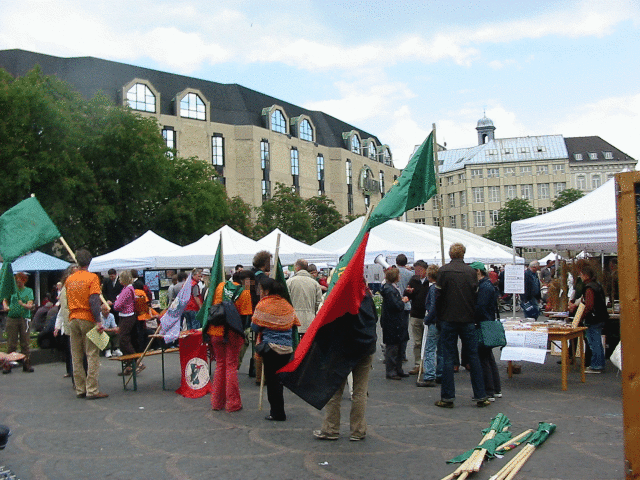
On Monday, May 19, a demonstration against the German Plant Breeders Association (BDP) and in front of the botanical garden at the University of Bonn took place.
About 30 activists and peasants protested against bio-piracy and patents on life. Afterwards at the International Diversity Market at the Munster square in the centre of Bonn, there was a street theatre and colonized seeds were given back to peasants from Asia and Latin America.
======

We combined our Bonn sightseeing tour with some adbusting. The city of Bonn has placed 450 billboards around the town: “Biological diversity needs our engagement” Nice, but oh so vague – they fail to say anything about how and why our lifestyles are destroying biodiversity, or how to preserve it. To prevent further loss of biodiversity we have to challenge not only our shopping habits, but also the corporate-governmental elites who are driving the destruction.
We decided to help the city and put forthward a clearer message. So we printed hundreds of speech bubbles to add to the billboards saying “Biological diversity needs our engagement”, with the following messages:
– …and our engagement needs action. Stop driving, start biking. –
– …and our engagement needs action. Boycott meat industry, go vegan! –
– …and our engagement needs action. Sabotage polluting industry. –
– …and our engagement needs action. Support small scale, instead of industrial farming. –
– Without you…nothing will happen. –
We also had some other posters that we put in suitable places, such as “Biosprit macht hunger”
Armed with glue and self-made billboard keys, we made our way through the centre. It was messy, great fun!
======
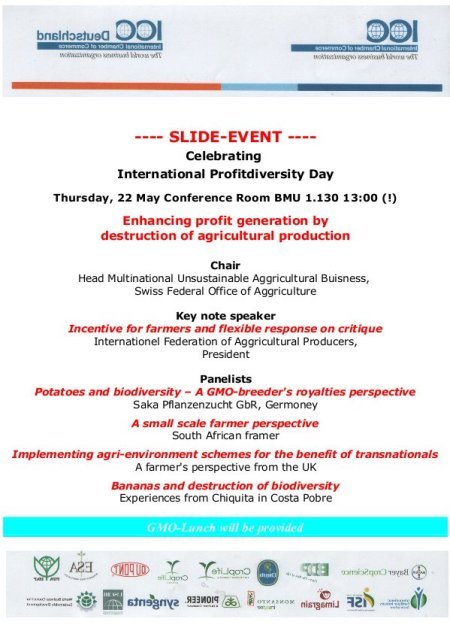

Happy Shareholders support Corporations at Business Lunch during COP9
Thursday may 22 is the UN day for Biodiversity. This was the occasion for a group of shareholders to visit a lunch-meeting organised by the International Chamber of Commerce, the lobby organisation of worlds largest corporations.
“We, ‘The Small Shareholders Initiative’, TSSI are very glad about the important issues we have to report on behalf of the International Profitdiversity Day today:
Business gets 220.000 US $ to support companies in their work at the CBD. This means that we can give our profits to the shareholders and still make people believe that we work for biodiversity.
During the high level meeting Thursday May 29, business rightly gets a full hour to present its ideas. All other stakeholders together have to share the other hour. Afterwards all delegates are invited, as part of the official programme, by business for a lunch. Another possibility to make the delegations do what we want.
Hear hear!”
The rest of the speeches of the happy shareholders you can read in the flyer they handed out to during the party: http://www.aseed.net/pdfs/SlideEvent_versionA5.pdf
======
Via Campesina Disrupts CBD
23.05.2008
VIA CAMPESINA JOINS BIODIVERSITY DAY CELEBRATIONS
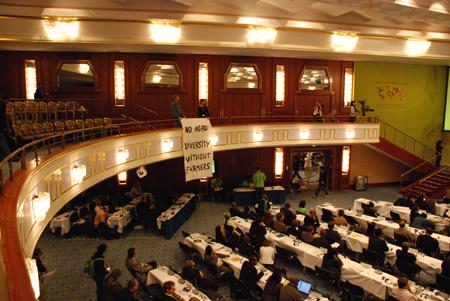
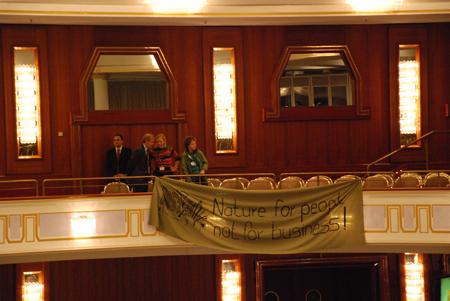
This afternoon activists from all over the world have hung a banner, banged on teacups and handed out messages by Via Campesina during the official celebrations of Biodiversity Day at the 9th Conference of Parties (COP-9) of the UN convention on Biodiversity. They did so at the end of a message by UN secretary general Ban Ki Moon read by the Programme Officer of the Secretariat of the CBD to the distinguished delegates of the Convention.
The banners read “No Agrodiversity Without Farmers” and “Nature for People Not for Business”. The written message was brought to the attention of the delegates by farmers’ group Via Campesina, who were refused to be part of the celebration ceremony just before biodiversity day.
According to Via Campesina as well as many other present at the convention small farmers are the key to both the solution to world hunger and the safeguarding of the world’s biodiversity.
Via Campesina also warns against corporate interests advocating for a new Green Revolution in Africa as a strategy to increase productivity. Although they use concepts such as “sustainability”, “participation”, and “biodiversity management”, the production model is the same as that which has created the present crisis and growing loss of biodiversity
Small farmers, though, have the ability to feed the world. Peasant agriculture promotes food diversity, sustains traditional cultures and does not burden the environment. Moreover, small-scale, local and ecological production is an effective and immediate way of reducing carbon emissions and cooling down the planet.
After a few minutes the banners were taken away by UN police officers and officials and the people holding them were escorted out of the Maritim Hotel, and lost their accreditation badges, which are required to participate in the meetings.
Members of Via Campesina were given a round of applause from the delegates when they chanted “nature for people, not for business”.
Prior to the banner hanging action, members of Aktionsbündnis COP9, Via Campesina and supporters disrupted an industry lunch where agro-industrialists were congratulating each other for their excellent work at monopolizing the seed supply and destroying agricultural biodiversity. CBD Executive Secretary Ahmed Djoghlaf, who has been criticized for his pro-industry actions, presented at the side event following the lunch.