
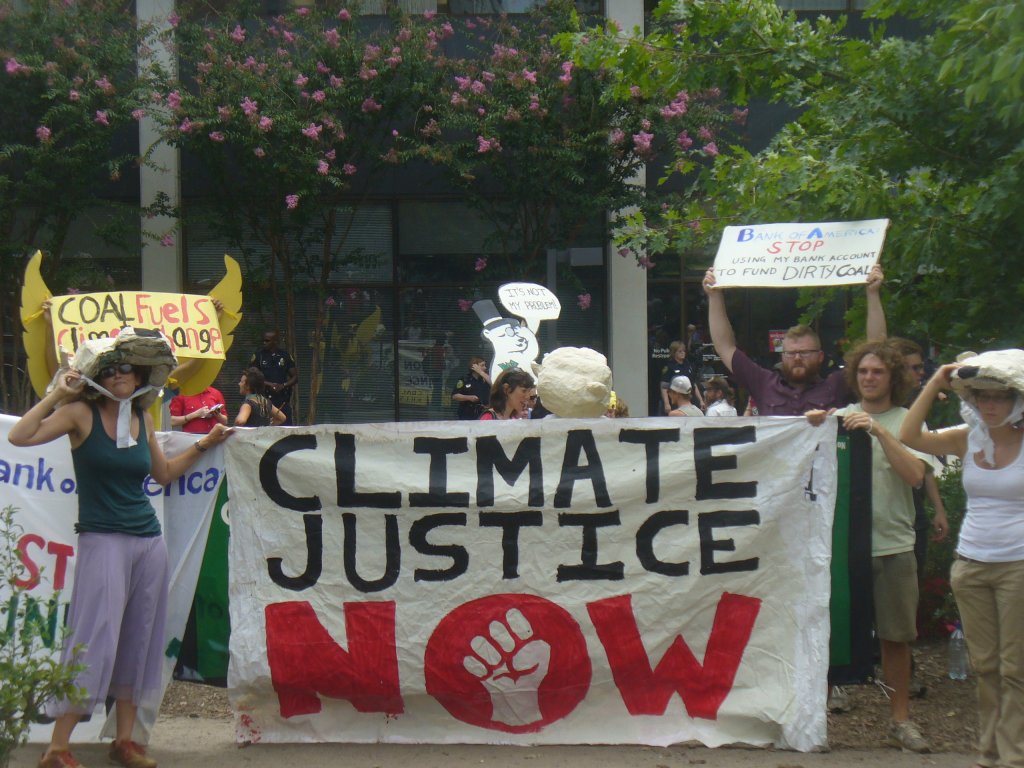
 Between August 8th-14th, 400+ people gathered for the West Coast Convergence for Climate Action. Participants took part in nearly 100 workshops, as well as lots of games and performances.
The event took place in Skamokawa, Washington in close proximity to a proposed liquefied natural gas (LNG) import terminal at Bradwood, Oregon. The Columbia River divides Oregon and Washington, and participants in the Convergence learned about attempts to sustain the local economy of the Lower Columbia River while resisting massive fossil fuel developments in the area.
On Monday, August 13th, Convergence participants were joined by dozens of local activists opposing the Bradwood LNG terminal. The group gathered on the Washington shore of the Columbia River, where hundreds of people live in close proximity to the Bradwood LNG proposal. Using fishing boats, sailboats, kayaks, and an umiak, participants in the action crossed the Columbia River and occupied the beach at Bradwood where NorthernStar Natural Gas intends to construct a large LNG terminal.
On Tuesday, August 14th activists locked down in front of the PacifiCorp (aka Pacific Power) building in Portland, Oregon to demand that the company shut down the four dams it operates on the Klamath river and stop developing coal fire power plants. The protesters were joined by a rally of several dozen supporters, many of whom wore hazmat suits painted with fake blood to draw attention to the poisonous conditions on the Klamath River.
No one was arrested at either action; it was generally concluded that the companies targeted wanted to avoid drawing the additional media attention that arrests would bring.
Monday’s action also featured a banner hang hung on a cliff adjacent to the Bradwood site, showing a target symbol and the words “Another LNG Disaster – What’s Your Number?” The “number” refers to recently released clasified pictures obtained anonymously showing that NorthernStar, developer of the LNG terminal, has numbered every structure within two miles. Local LNG opponents first exposed this disturbing mapping project during Clatsop County land use hearings, with one resident asking, “If we’re not going to be impacted at all, then why is there a number on my roof in this picture?”
The global impacts of the LNG industry were also a focus of the Climate Convergence, where participants learned that LNG is up to 40 percent more carbon intensive than natural gas due to its long supply chain (LNG must be extracted as natural gas, liquefied, shipped huge distances, and ultimately re-gasified). Recent studies show that LNG is comparable to gasified coal (aka “Clean Coal,” a true oxymoron – see post about SE Convergence!) in its carbon impacts. Furthermore, local LNG opponents shared what they had learned about the global LNG industry, having communicated with opponents of LNG producing facilities in Indonesia and Russia. In these places, the severe economic, environmental and human rights impacts of LNG development are multiplied many times over in comparison to the experience of rural Oregon and Washington.
Beyond climate change issues, the West Coast Convergence used the carbon trail of various energy sources to put the environmental, human rights, and labor practices of the fossil fuel industry on display. Speakers addressed a huge variety of issues pertaining to coal, natural gas, and hydropower issues while others used the event to demonstrate skills and sustainability practices that can preclude the need for destructive fossil fuels and hydropower.
The Convergence was met with strong local support — nearly 100 people from the surrounding rural counties in Oregon and Washington participated — and important exchanges between those fighting fossil fuel development on local, regional and global scales. Participants came from as far south as Southern California and as far north as Alberta and Vancouver Island.