
 13th June In recent years, the annual dolphin hunts in Taiji, Japan, have garnered headlines worldwide and sparked outrage among activists, scientists, celebrities,
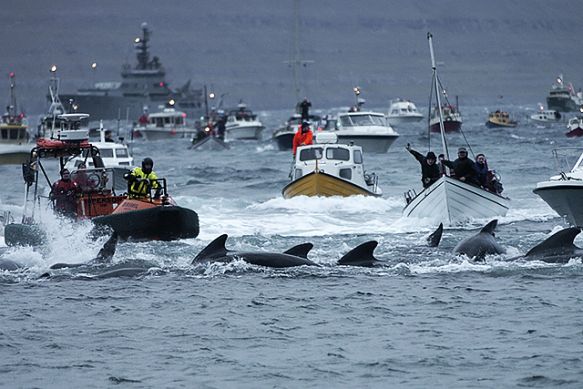 13th June In recent years, the annual dolphin hunts in Taiji, Japan, have garnered headlines worldwide and sparked outrage among activists, scientists, celebrities, and diplomats. But half a world away, in the North Atlantic nation of the Faeroe Islands, a similar slaughter has received far less scrutiny.
That’s about to change. On Friday, Sea Shepherd Conservation Society USA will unveil details of a new hi-tech initiative aimed at disrupting and halting the whale hunts, which begin this month and continue through September.
The annual hunts are known as “grinds.” As part of “Operation GrindStop 2014,” a land-based campaign, Sea Shepherd USA will deploy drones and livestream video to hinder the slaughter. Other Sea Shepherd organizations will launch simultaneous water-based campaigns.
Why the drones? They are “primarily for surveillance and documentation,” Sea Shepherd founder Paul Watson said in an email. “They are inexpensive and easy to operate, and they can get us into places we could not otherwise get to.”
Combined with livestreaming video, drone technology “will allow us to cover the more than two dozen beaches in the Faeroes where whales may be killed,” Watson added. “The Faeroes present some logistical challenges, and we need to be able to deploy in such a way that all possible kill sites are monitored at all times.”
Drones might also detect approaching whales, he said, which would “allow us to take our boats to deflect the pods away from the islands.” (The Faeroe Islands campaign is funded in part by the Skoll Foundation, part of the Jeff Skoll Group, which includes Participant Media, TakePart’s parent company.)
Sea Shepherd USA will place four teams of at least 15 activists each on the ground.
Residents of the windswept Faeroes, a self-governing archipelago of Denmark between Norway and Iceland, have been killing fin whales, pilot whales, Atlantic white-sided dolphins, and other small marine mammals for centuries. Though the slaughter has received a smattering of attention in the global media, the Faeroes hunt has been largely overshadowed by the dolphin drives in Taiji, which were chronicled in the Oscar-winning documentary The Cove.
As many as 1,000 endangered long-finned pilot whales, along with members of other species, are killed each year in the Faeroes during the “traditional” hunt, called grindadráp (“grind”) by islanders.
The hunt is even promoted as a tourist attraction. According to the Visit Faroe Islands website, one of the country’s main attractions is whaling.
“The pilot whale hunt in the Faroes is, by its very nature, a dramatic sight,” it states. “Entire schools of whales are killed on the shore and in the shallows of bays with knives which are used to sever the major blood supply to the brain.”
The method is “the most efficient and humane” means of killing “under the circumstances,” the website reassures potentially queasy tourists, “but it naturally results in a lot of blood in the water.”
This is not the first time that Sea Shepherd, which has been fighting against the Faeroes slaughter for more than 30 years, has used drones in a campaign, according to Jake Weber, Sea Shepherd drone specialist. But it is the first drone deployment in the Faeroes, he said in an email. “A great advantage they will provide is the ability to get [high-definition] footage and still photos very close to the grind without endangering our volunteers or their equipment.”