
USA: Protesters Blockade Monsanto Seed Facility in California
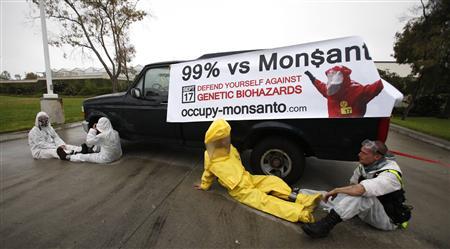
Opponents of genetically engineered foods blocked shipments and deliveries yesterday at Monsanto Co’s vegetable seed company that developed a new genetically modified sweet corn that will hit stores this fall.
The protesters, who want to remove all so-called genetically modified organisms (GMOs) from the food supply, say their action is a preview of about five dozen other events planned for countries around the world next week.
 They also hope to drum up support for a California ballot measure that would require food sellers to label a broad range of products, including soup, soy milk, breakfast cereals and chips, that contain GMOs.
Monsanto and other developers of these biotech crops say they are safe. But U.S. regulators do not require any independent safety tests that would put a lid on doubts raised by consumers and some scientific and health groups.
More than 40 countries around the world have some requirements for labeling foods containing ingredients from genetically modified crops. But U.S. regulators have rejected requests by many groups for similar labeling rules, and as a result many Americans do not know that they have been eating GMOs for years.
At the protest on Wednesday, about a dozen people organized by a network of anti-GMO activists called Occupy Monsanto stopped trucks from entering or leaving Monsanto’s Oxnard, California-based Seminis for nearly six hours.
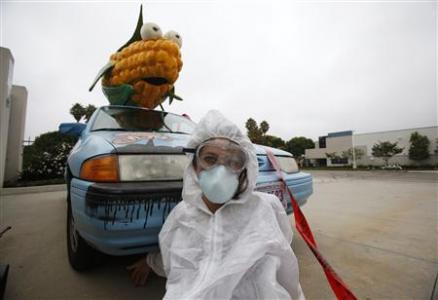
The activists, some dressed in biohazard suits, blocked truck entrances with cars and chained themselves to the vehicles.
Police arrested nine of the protesters and charged them with trespassing, organizers said.
Seminis’ biotech sweet corn is one of the newest GMO crop products to make it to market. The corn was altered genetically to withstand dousings of a common weedkiller and to ward off certain pests.
“We deserve to know what we are eating and we should put GMO crops back in the lab and off the kitchen table,” protester Rica Madrid said.
Occupy Monsanto is not affiliated with the backers of a California proposal to label foods that are made with crops or from animals that have had their genetic makeup altered in the laboratory.
Monsanto did not directly address Wednesday’s events but said the company’s work helped improve farm productivity and food quality.
“We respect each individual’s right to express their point of view on these topics,” Thomas Helscher, a Monsanto spokesman, said of the Seminis protest.
DIFFERENT VIEW IN EUROPE
GMOs are deeply unpopular in Europe and many other countries, but they eventually came to dominate key crops in the United States after Monsanto in 1996 introduced a soybean genetically altered to tolerate Monsanto’s Roundup weed killer.
Using genes from other species, Monsanto and rivals including DuPont and Dow Chemical have since introduced an array of genetically altered crop varieties.
The most popular genetically engineered crops in the United States include corn, soybeans, sugar beets and canola – staple ingredients in a wide array of popular packaged foods.
Proponents of GM crops say they make farming more efficient by making plants resistant to pesticides, pests and harsh growing conditions, such as drought. They say genetically modified crops are no different from conventional types and that increasing demand for food, biofuels and livestock feed can only be met with help from the biotech industry that Monsanto dominates.
Critics say GM crops have not always lived up to their promise and that the benefits to farmers do not outweigh myriad risks to human and animal health and to the environment.
Assessing such risks is difficult in the United States. The government does not require GMO crops to undergo independent safety testing before they are approved, and it does not require labeling for GMO content which makes it next to impossible to track any links to human health problems.
The World Health Organization says “individual GM foods and their safety should be assessed on a case-by-case basis.”
Recently, some U.S. scientists have raised alarm bells over what they see as potentially dangerous implications from overuse of GMO crops.
Among the concerns is the fact that the rapid adoption by U.S. farmers of genetically engineered corn, soybeans and cotton has promoted increased use of herbicides, which critics say has triggered an epidemic of herbicide-resistant weeds and more chemical residues in foods.
This week, the Center for Food Safety vowed to sue the U.S. government if it approves a new type of genetically altered corn developed by Dow.