

 Update: no arrests made, Monsanto closed for whole day, workers sent home, and some of the corporate sculptures got a re-paint!
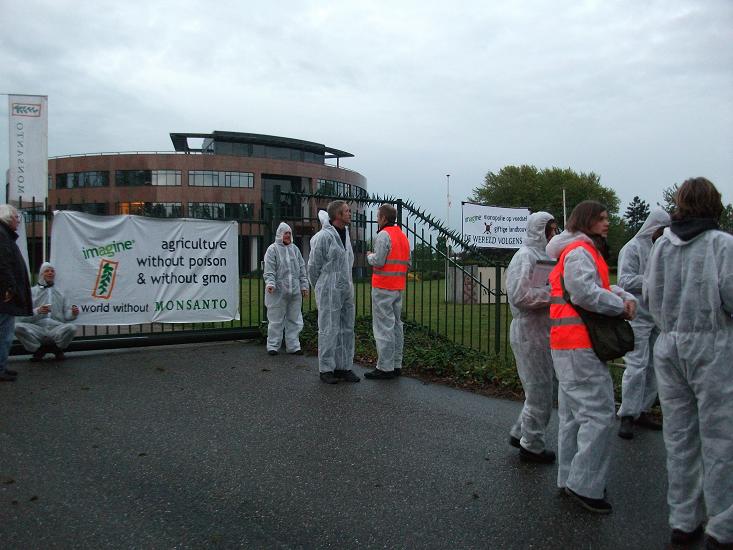
On Monday 17 May a group of 50 people from the group “Roundup Monsanto” blockaded the Monsanto office at Bergschenhoek in the Netherlands.
Verdelg Monsanto
Press Release: Blockade of Monsanto’s Bergschenhoek Location in The Netherlands
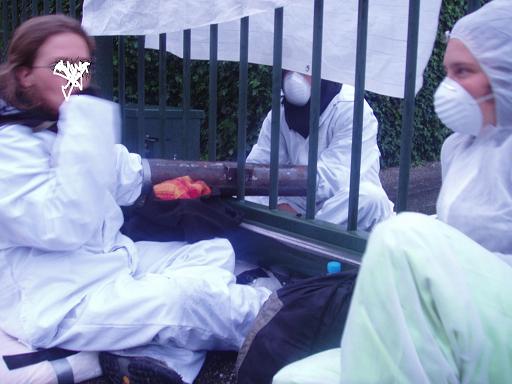
Bergschenhoek, Monday, May 17 – Since 6 o’clock this morning, 50 persons of the action group ‘Roundup Monsanto’ are blocking both gates of the Monsanto seed company near Rotterdam. ‘Roundup Monsanto’ wants Monsanto to back out of the seed market, and demands an end to patents on seeds and living organisms. Monsanto and other agro-chemical multinationals are lobbying the Dutch government and the EU for legislative changes that would make it easier for large companies to take control of the seed market and food production.[1]
The blockade is taking place at the former De Ruiter Seeds, acquired by Monsanto in 2008, where research laboratories, offices, greenhouses, and a central storage for seeds and seedlings are to be found.
The chemical company Monsanto has 23% of the worldwide market of commercial seeds in its hands. In the last 5 years, the company has bought up three large internationally active seed companies in the Netherlands: De Ruiter Seeds, Western Seeds, and Seminis. As a result, Monsanto now dominates the world market for vegetable seeds and seedlings. In addition, Monsanto is the market leader in genetically engineered soy, corn, sugar beets, and cotton, and has a large market share in pesticide sales. “Farmers and vegetable growers are becoming increasingly dependent on these big seed companies and patented seeds will make the situation even worse,” says Flip Vonk, an organic farm employee present at the action.
Monsanto is a chemical company which has grown large due to the production of pesticides, Agent Orange, and PCBs. [2] After countless scandals revolving around these chemical substances, the company found a new market strategy: development and sales of genetically manipulated crops. These crops are cultivated in enormous monocultures, with excessive use of fertiliser and pesticides. Monsanto represents a destructive model of chemical agriculture.
The current system of agriculture, based on mass import and export, is completely dependent on the consumption of fossil fuels. Chemical agriculture is responsible for a quarter to a third of the release of all the greenhouse gases. Over 80% of the cultivated GMOs are pesticide resistent, the remaining 20% produce insecticide inside the plant. This form of food production is extremely harmful to people, nature, and the climate. Genetical engineering will not contribute any solution to climate change.
Genetic engineering is often presented as a solution to the global food question. But in spite of 15 years of cultivation of genetically manipulated crops, 2009 witnessed a record amount of starvation. GM crops have not increased yields. “The food problem requires completely different solutions. We need to drastically change course, away from large-scale chemical agriculture, towards local food production in harmony with nature, without pesticides and without genetically manipulated crops. A world without Monsanto is a good step in that direction,” according to Miranda de Boer from ‘Roundup Monsanto’.
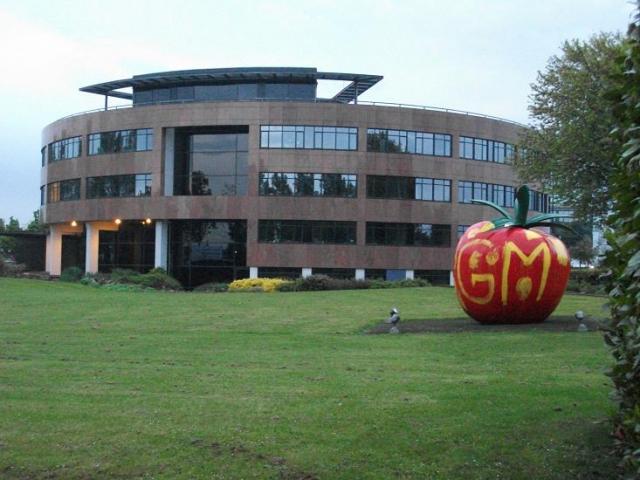
The two most important access doors to the Monsanto terrain have been closed off. The action group put up banners with the message “Imagine, monopoly of food, poisonous agriculture, The World according to … Monsanto”, adbusting the company’s logo. It has also adjusted the giant cucumber and tomato on the lawn to Monsanto’s manipulated reality. Employees and customers are greeted with coffee, tea, and background information on arrival.
**********
to the editors:
action location: Leeuwenhoekweg 52, Bergschenhoek (North of Rotterdam)
contact: verdelg-monsanto@riseup.net
[1] For further information about the development of patent law and breeders’ rights, consult a press release from A SEED Europe about the subject: http://www.aseed.net/kwekersrecht-vs-patentrecht
[2] See the film ‘The World According to Monsanto’
More background information can be found at:
– http://www.gentech.nl
– http://www.gmwatch.org
– http://www.no-patents-on-seeds.org
– http://www.aseed.net/monsanto
– http://www.combat-monsanto.co.uk
– http://www.toxicsoy.org
Action video – http://www.vimeo.com/12529960
——
Two GM potato trials this year
The UK government in their GM madness have just (7.4.10) approved a new GM potato trial to go ahead at the Leeds University farm near Tadcaster. It is also likely that they will approve a second, different trial by the Sainsbury Laboratory at the John Innes Centre, Norwich.
These trials are experimental trials, and not part of an application to grow the potatoes on a commercial scale. The GM potatoes are still in the development stage and these trials are designed to find out whether the genetic manipulation works in field condition. If this is confirmed then they might go on to be developed for commercial growing.
Despite massive public resistance and growing evidence that GM does not increase yields, is extremely damaging to the environment and impoverishes farmers around the world, our government is pushing GM onto our plates. GM continues to be very lucrative for multinational biochemical corporations… while farmers around the world are rising up in protest against this technology of control.
The latest con promoted by the GM spinners is that GM will provide the answer to climate change. Rather than cutting carbon emissions, stupid…
Leeds trial:
The Centre for Plant Sciences at the University of Leeds has been given consent by Defra to conduct field trials of GM potatoes engineered to resist potato cyst eelworm or potato cyst nematode (PCN).
This is a different GM potato to the one previously trialled in 2008 and different to the potatoes proposed to be trialled in Norfolk, but many of the problems are the same.
The trials commence from 1 May to 3 November 2010 and continue for 3 years until 2012. They take place at the Leeds University Farm at Tadcaster, North Yorkshire covering not more than 1,000 square metres with up to 4,000 GM plants per year.
They are engineered to be resistant to nematodes, a pest affecting potatoes that can effectively dealt with through good farming practises
There is no need for GM to address this pest, nor is there any market for GM potatoes, so the trial should not go ahead.
Full details of the trial can be found here (including grid references)
http://www.defra.gov.uk/environment/quality/gm/regulation/registers/consents/index.htm
Norwich trial
The Sainsbury Laboratory at the John Innes Centre, Norwich has applied to Defra to conduct field trials of GM potatoes engineered to resist late potato blight. These potatoes contain genes from a potato relative from South America and have been engineered to be resistant to blight, a potato disease. They are different from the genes in BASF’s GM blight resist potatoes field tested near Cambridge in 2007 and 2008. The BASF trial was abandoned last year, for unknown reasons.
The release of GM potatoes would commence from 1 May 2010 and run to 30 November 2010 and continue for a further 2 years until 2012. The release would take place at the John Innes Centre, Norfolk, in an area of 1,000 square metres with 200 square metres used each year for GM potatoes with not more than 200 GM plants per year.
The decision is expected in the next couple of weeks.
A detailed briefing on the GM spuds can be downloaded from
http://www.gmfreeze.org/page.asp?ID=417&iType=1083
The full application to Defra can be found here (including grid references)
http://www.defra.gov.uk/environment/quality/gm/regulation/registers/applications/index.htm
Liberate the fields!