
 26th January 2010
Authorities in the southwestern Chinese region of Guangxi have sealed off a village and ordered a news blackout following violent clashes between local residents and police in a land dispute.
“The villagers put up some reports about what happened on the Internet, but they were taken down by the authorities very quickly,” said a resident of Tongle township near the scenic tourist city of Guilin.
“Right now the authorities have totally sealed off the area. The villagers are using text messaging to exchange news,” said Zhang, adding that he had been warned by other villagers that the police were still detaining people.
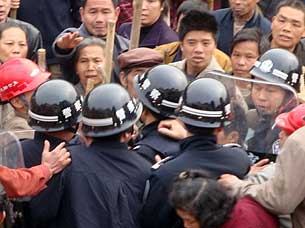
Zhang said riot police fired tear gas and used electric shock batons on elderly protesters trying to prevent the takeover of their farmland for development.
“Things got very serious at the scene,” he said. “The people trying to protect the land were all elderly, women, and children. How could they resist?”
“They were attacked by the riot police first, and a lot of those injured were then taken away by police.”
Photos posted online of the clashes showed crowds of people, many of them elderly, some of whom had sustained injuries to their arms and legs. Some showed people bandaged, and still bleeding from head injuries.
‘Handled according to law’
An employee who answered the phone at the Pingle county government, which oversees Tongle village, said the authorities had already issued the legally required amount of compensation to the villagers.
“Our leaders here have already dealt with this situation,” the employee said. “Everything we did went through the municipal level authorities for approval, and the entire affair was handled according to law.”
An official who answered the phone at the Guilin municipal politics and law committee confirmed the clashes had taken place as part of a land dispute.
“There was a land dispute there. But I haven’t got time to explain the details to you.”
An official who answered the phone at the Guilin municipal public security department declined to comment on the incident.
However, an officer at the Tongle village police station said: “We are currently dealing with this issue. If you want to know more, you’ll have to go to the [county level] public security department.”
Cut off
Local residents said around 700 riot police were dispatched to the village, and that the community was still cut off from the outside world.
An engineer surnamed Li at the Tongle Village Transformer Station said police had sealed off several entrances to the village, and blocked roads in the area.
“Right now, vehicles from outside can’t get into Tongle village. The roads have all been sealed off by the authorities,” Li said.
“They have blocked the exit for the village on the Chajiang Bridge highway.”
The dispute flared after villagers saw officials begin to move in to begin work last Tuesday on a plot of around 1,000 mu (67 hectares) of land in the village, which was requisitioned more than two years ago by the Pingle county government for redevelopment.
Local residents were angry because the authorities had sold the land for 10 times the amount of the compensation doled out to villagers, and because they have been promised 20,000-30,000 yuan (U.S. $4,394) per mu but have yet to receive it.
An open letter posted online by villagers cited guidelines issued by the central government, which “states clearly that it is not permitted to take possession of the land before the compensation has been paid.”
Rural communities ‘disempowered’
Yao Lifa, a civil rights activist from the central province of Hubei, said such land disputes involving violence between police and local residents are increasingly common.
“China rural communities have been a disempowered segment of the population all through the past 60 years of Communist Party rule in China,” Yao said.
He cited comments made publicly by cabinet-level official Cheng Xiwen, who said that around 80 percent of land disputes across China were the result of illegal actions by government officials.
“The people have no power to oversee the government,” Yao said.
“Official and commercial interests nowadays are the same thing, combining forces in an alliance which has a huge amount of power.”
“There is no evil that they will not stoop to.”
He called on central government officials to take note of events in Guilin and help protect the villagers’ rights and interests.
Land disputes have spread across China in recent years, with local people often complaining that they receive only minimal compensation when the government sells tracts to developers in lucrative property deals.
Attempts to occupy disputed land frequently result in violent clashes, as police and armed gangs are brought in to enforce the will of local officials.