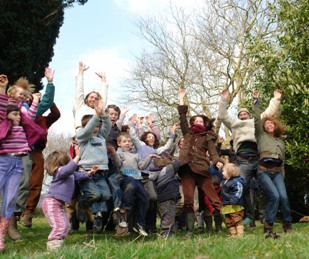
Today the Lammas group won planning permission for their ecovillage project.
Lammas is a new settlement of 9 eco-smallholdings, a campsite and a community hub building, to start construction this autumn. It will be sited on 76 acres of mixed pasture and woodland next to the village of Glandwr, Pembrokeshire. The site is on land currently belonging to Pont-y-gafel farm, next to the village of Glandwr, North Pembrokeshire. The site is currently used as farmland.
After their first application was turned down for insufficient detail, Lammas put in an amended application on March 17th 2008. The first application had filled an entire wheelbarrow (the second containuing 150 illustrations and 1200 pages of text would have requuired 2 barrows — so it was submitted electronically!) However, their second application was again turned down in September 2008. Further frustration was experienced when the Welsh Assembly refused them the right to appeal on the grounds that the application was invalid on some technicality. However, appeal they did, and the appeal into the refusal of the revised planning application was heard earlier this summer. The inspector, intrigued and unvonventionally, chose not to allow lamma’s expert witnesses to present their full cases in favour, preferring to open the debate about the application to the whole floor so that all voices in favour and against the application were heard. Insptector took a few weeks to reach his decision in considering the whole application.
Despite the launch of a pioneering low-impact policy by Pembrokeshire County Council in 2006 and years of meticulous groundwork, consciencious dedication and patient deliberation, the long exacting process sought for approval of the project has taken over 2 years since the initial application was first submitted. Emphasising the imbalance of the current planning system which doesn’t take account of climate change, Paul Wimbush of the Lammas project even suggested that it would have been easier to have applied for planning permission to build a power station! That it has succeeded is due to a tremendous drive to succeed born of an inspirational vision of low impact/low carbon living for the 21st century.
Lammas was conceived as the first large-scale low impact project that would work with the planning system, (ie: to apply for planning permission in advance of the construction and establishment of the project, or in other word, not retrospectively). The Lammas Ecovillage will be completely independent of all mains services. All water will be sourced from the site using a combination of an existing spring for drinking water and rainwater harvesting from rooftops. All electricity will be produced on site using renewables. Fortunately there is an existing water turbine system on site which Lammas plans to renovate. All organic waste will be composted on site using a combination of compost toilets, wormeries and compost heaps. Fuel, in the form of coppiced willow and elephant grass, will be grown on site.
The project will be managed by Lammas Low Impact Initiatives Ltd, a cooperative registered under the Industrial and Provident Society Act. A comprehensive management plan has been compiled which sets out how the project will be established and run.
The smallholdings will essentially be agricultural leaseholds which are conditionally tied to requirements as set out in the management plan. Thus the objectives of the project will be assured in the long term. The requirements will cover issues such as livelihood, transport, services and monitoring.
The people selected for the first phase of the project have developed well researched plans for their livelihoods. In addition to sourcing fuel, water, electricity and food from the site, the 9 households will also run small-scale farm businesses producing a wide range of quality goods including hazelnuts, smoked ham, soft fruit, woodland crafts, vegetables and cooked foods. The produce will be marketed through a variety of outlets including local shops and a Lammas market stall.
Common Land
Some areas of the project will be managed in common. There is an area of existing broadleaf woodland on site which will be conserved for its wildlife value. The existing conifer woodland will be managed and harvested as a resource for building. There will also be shared grazing and fuel crop areas as well as a millpond and village green.
In hindsight
As Larch Maxey has written: “Lammas softly-softly approach, seeking to work with the planning system, has led to huge delays while prospective residents living locally [have poured] savings into inadequate accomodation. Opportunities to harness people’s energy have been lost. Whilst it remains invaluable to have the Low-Impact Development movement broadened by projects seeking planning permission before moving on, the planning system is ill equipped for the speed and scale of the challanges we face. Until it is equipped, people must continue to take direct action towards the sustainability transition in every way they can {including} building low impact lives”.
More Info:
Ref: http://www.lammas.org.uk/ecovillage/news.htm