
Indians Block Ecuador Highways to Protest Mining
January 20, 2009
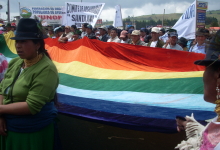 QUITO — Indian groups in Ecuador started blocking highways before dawn Tuesday in protest against the new mining law, while Interior Minister Fernando Bustamante asked that the demonstrations be carried out peacefully.
The Confederation of Indigenous Nationalities of Ecuador, or Conaie, and some environmental groups called for nationwide protests against the new law, which they believe will harm the environment and favor multinational mining companies.
According to media accounts, indigenous groups began blocking highways at sunrise, above all in the country’s Andean region, although government officials said that these demonstrations were not really significant.
North of Quito some 1,000 Indians stalled traffic before dawn on the Pan American Highway with tree trunks and stones, witnesses said.
Those blockades and similar actions have not resulted in any serious clashes with police, authorities said.
Miguel Torres, an Indian leader in the northern province of Imbabura where the police have kept the road to the capital from being cut off, said on Radio Quito that “the blockades will be progressive.”
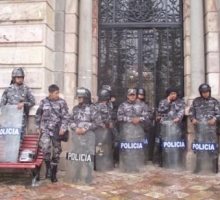
Another Indian leader said on the Teleamazonas network that police stopped demonstrators from entering the capital for a planned demonstration and march to Congress.
“Groups that want to protest against the mining law or anything else can do so, they have the right, they have freedom of expression and can give their points of view, but we are going to require that they do so with respect for law and order,” the interior minister said in an interview on Sonorama radio.
“If they block highways or take any other action that keeps people from carrying on with their normal lives, we’ll have to intervene and do what the law requires in such cases,” Bustamante said.
After the statement President Rafael Correa made Monday that there are groups out to destabilize the government, the minister said that “some leaders” of these groups may have such an intention, but he doesn’t believe “that together the demonstrators have that idea.”
Correa, a left-leaning, U.S.-trained economist, says the new mining law includes environmental safeguards and accuses the measure’s opponents of engaging in “childish leftism and environmentalism.”
———
Ecuador Anti-Mining Blockades Met With Repression, National Mobilization Called for January 20
9 January 2009
The ongoing conflict over mining in Ecuador escalated this week as blockades shut down highways throughout the country’s Southern Andean highlands and Amazon rainforest, while nationwide protests have been called for January 20.
The government of President Rafael Correa has assumed an aggressive posture, insulting indigenous and environmental activists and pledging to secure approval for a controversial new Mining Law. Canadian companies hold the majority of mining concessions in Ecuador and are pressing for a new law that would allow for large-scale, open pit metal mining.
A number of leaders have been arrested and other protesters were beaten and shot at by police. Campesino and indigenous protesters, who depend on clean water to farm and for drinking water, are demanding that the government shelve President Rafael Correa’s proposed Mining Law, saying that it would be a social and environmental disaster. The rural blockades follow months of regular protests in Quito and other parts of the country.
Protesters also argue that the law contradicts important provisions of the new constitution protecting water, the environment and indigenous peoples’ rights. The document drew international attention for awarding legal rights to nature. The new constitution, approved by popular referendum in September, is the centerpiece of Correa’s first term.
After emergency meetings on January 7, the Confederation of Indigenous Nationalities of Ecuador (CONAIE) called for a national mobilization on January 20, calling the government “dictatorial.” It is unclear whether the January 20 mobilization will spread road blockades to other provinces in central and northern Ecuador. Protesters are demanding a dialogue with central government leaders and for a broad national discussion on mining before any legislation is passed.
Some protesters in the Southern provinces of Zamora Chinchipe and Morona Santiago suspended their blockades for 24 hours in response to the provincial governor’s promise to reach out to Francisco Cordero, the President of the Congresillo, Ecuador’s interim legislature. Other blockades were suspended in anticipation of the nationwide actions.
The blockades began on Monday January 5 in the Southern province of Azuay, cutting off much of the traffic into and out of Cuenca, Ecuador’s third largest city. Over the next few days, the protests spread to the neighboring Andean province of Loja and to the Amazonian provinces of Zamora Chinchipe and Morona Santiago.
In Giron, Molleturo, Tarqui (Azuay), Limon Indanza (Morona Santiago) and in El Pangui (Zamora Chinchipe) protestors have been beaten or shot by police. Police officials and journalists were released after being briefly detained by campesinos.
On January 6, campesino leader Vicente Zhunio Samaniego was arrested in the Southern province of Morona Santiago, showing up 16 hours later in a hospital with bullet wounds to the head. On January 7, protest leader Miguel Ángel Criollo and his son Orlando were arrested in an early morning raid on the village of Pueblo Nuevo in Azuay province. The newspaper El Universo reports that over fifty police officers from the Special Operations Group (GOE) took part in the raid. When villagers tried to defend the Criollos from arrest, police fired tear gas, forcing the evacuation of a local school.
In the city of Cuenca, police violently repressed protests at the Court of Justice. As six leaders began a hunger strike inside the building, the police attacked a press conference taking place outside the building, arresting Water Board leader Carlos Pérez Guartambel. Police used tear gas to disperse protesters attempting to defend Pérez. Police then forced hunger strikers and four women supporting them out of the Court building, dragging them by their necks. The governor of Azuay denied that Pérez was arrested, and he was freed later that day. The six hunger strikers are now in Cuenca’s San Roque Church.
According to the newspaper El Comercio, Minister of Mines and Petroleum Derlis Palacios said that the government would push forward with the Mining Law. Palacios said that Ecuador “was a poor country that could not afford to just sit on these large resources.” He added that protests were the result of manipulation by indigenous leaders who mislead community members by claiming that mining would harm their access to clean water. Palacios said that the new law would ensure that water sources are protected. Congresillo President Cordero told El Comercio that protesters were using the demonstrations to advance electoral ambitions.
The CONAIE condemned the government’s description of protesters as “criminals and subversive terrorists,” saying that “the only thing we are fighting for is life and dignity for all of Ecuador’s citizens.” The CONAIE that such comments are aimed “to stigmatize [protesters] and prepare public opinion for even more severe repression.”
Correa is coming into increasing conflict with social and indigenous movement activists. On Thursday January 8, the United Labor Front (FUT), Ecuador’s largest labor federation, announced mass protests for a higher minimum wage increase for January 15. They say that Correa’s proposed increase of $18 a month, to $218, is a step back and fails to meet provisions in the new constitution ensuring that all Ecuadorians are paid a living wage.
———
Ecuador Protesters Release Police Doctor
8 January 2009
QUITO — Peasants protesting in southern Ecuador against the approval of a new mining law drafted by the government on Wednesday freed police Capt. Eduardo Castillo, a doctor who had been taken hostage at the beginning of the week, Ecuadorian media reported.
Castillo was taken hostage on Monday when demonstrators burned the ambulance he was riding in.
After spending 35 hours in captivity, Castillo is now in a clinic in Cuenca, in the southern mountainous part of the country, where he is recovering from bruises and cuts in several places.
“They kept me in a type of hole. I spent all morning there. They tied me up and beat me,” Castillo told reporters.
On the third day of the protests, small miners, peasants and environmental groups continued to block roads and engage in confrontations with police in the country’s southern provinces.
The demonstrators are asking that the mining law – which this week is being debated in the Legislative Committee – be shelved because they feel that it threatens the environment and favors the large-scale exploitation of mineral resources at the expense of small mining operations.
More than a dozen police have been injured and a like number of demonstrators have been arrested during the protests, which have been centered in the provinces of Azuay, Zamora Chinchipe and Loja, especially near the Andean city of Cuenca.
———
Ecuador Residents Protest Against Mining Without Environmental Protection
January 07, 2009
QUITO — Hundreds of peasants in Ecuador’s southern Andean region blocked roads on Monday to protest lawmakers’ expected approval of a new mining law that opponents claim doesn’t do enough to protect the environment and rural communities.
The militants piled sticks, rocks and piles of burning tires on the three main routes into Cuenca, the biggest city in the southern highlands.
Four protesters were arrested, three police officers injured and an ambulance set on fire in Molleturo, near Cuenca, reporters said.
The president of the Union of Water Systems in Azuay province, Carlos Perez, told journalists that the roadblocks will continue until Ecuador’s Congress either shelves the proposed legislation or sends a commission to the region to see the environmental harm done by existing mining projects.
The 120 police deployed to Cuenca were unable to clear the roads.
Separately, scores of independent miners arrived in Quito to demand that the congressional committee now reviewing the bill amend the text to include provisions legitimizing small mining cooperatives.
President Rafael Correa’s leftist government says the peasants’ objections to the proposed law are unwarranted, as the measure includes strict environmental safeguards.
The administration criticizes the demonstrators as “childish,” asserting that mining, if properly regulated, can be part of lifting Ecuadorians out of poverty.
Though the Andean nation produces nearly 600,000 barrels of oil per day, roughly 70 percent of the population remains poor.
———
Indigenous anti-mining protests hit Ecuador
 On Dec. 21, more than a thousand indigenous and campesino activists marched to the Ecuadorian National Assembly in opposition to President Rafael Correa’s proposed mining law. In the Southern Province of Azuay, campesinos blocked a number of highways, resisting police efforts to dislodge them. Protesters said that large-scale mining would damage Ecuador’s environment and pollute rural communities’ water.
The Mining Law, currently under debate in the provisional National Assembly, or Congresillo, would replace the Mining Mandate passed in May of this year. The Mandate froze mining operations and revoked a number of concessions to foreign corporations. The law would create a National Mining Company and increase state control over foreign corporations, which are largely Canadian. But the law would also allow mining to take place anywhere, including in protected areas and sharply limit community input.
In Quito, buses arrived from throughout the country to protest the mining law. Marching to the National Assembly, protesters clashed with police, who used pepper spray to push back activists intent on meeting with legislators. A small delegation was allowed to enter in the afternoon. The protests were organized by the Confederation of Indigenous Nationalities of Ecuador (CONAIE) and the Coordinator for the Unity of the Left and for Life, a new organization dedicated to regrouping social movements to confront Correa.
The march is possibly a prelude to a nation-wide uprising. While the protest was not large by Ecuadorian standards, representatives from many communities were present. Earlier this month, more than 30 organizations gathered in the Amazonian city of Coca and agreed to oppose Correa’s business friendly policies. Former Correa spokesperson and Assembly Member Monica Chuji said, “Today is a first step in a broader process of unifying social movements. Today we don’t have quantity, but we have unity.” Chuji, an Amazonian Kichwa, broke with Correa’s Alianza País Party in September, accusing the president of opposing indigenous rights.
Correa insists that responsible mining is necessary for Ecuador’s development. In November, Correa accused the indigenous movement of “losing their compass and playing into the hands of sectors that they have historically criticized, such as the Right, which the current administration is combating.” Correa has threatened to send the Mining Law to a national referendum if the indigenous movement alters it or blocks its approval, accusing the CONAIE of being anti-democratic.
But Dr. Byron Real López, an expert in environmental law, wrote in a recent report that the Mandate “is concerned with solving important issues. … such as the corruption surrounding the indiscriminate granting of concessions. But the proposed law ignores the ecological and social conflicts that mining activity causes. … and thus would tend to aggravate them.” López argues that the proposed law would violate a number of provisions in the new constitution, such as those protecting the rights of nature and indigenous communities.
Juan Francisco, a young Kichwa, traveled from the Southern province of Cañar. “We will never let them into our territory, which provides our water. Responsible mining is a miserable lie that the government wants to sell to us.” Juan Francisco said that the government should instead support sustainable and organic farming.
Despite Correa’s dismissive comments, it appears that the government is taking the movement seriously. Two days after the protests Ecuador’s interim legislature, the Congresillo, announced that they were considering extending discussion on the law by seven days – potentially pushing back a vote until Jan. 12. On Dec. 26, Congresillo President Francisco Cordero began a series of meetings with social movement leaders opposed to the project. The stated objective is to incorporate critics’ perspectives before the proposal undergoes a second debate, the last step before a vote.
But the CONAIE demands that the law be shelved so that a national debate on mining can take place. And protesters were adamant in their opposition to large-scale mining.
Carmen, a Saraguro Kichwa woman from the Southern province of Loja, said, “We oppose the Mining Law because we love nature. Mining will kill us, it will poison the water with chemicals. We all drink this water and we all will die. Water doesn’t belong to anyone. It belongs to us all.”
Campesino Jorge Marin traveled hours by bus from the Southern Amazonian province of Morona Santiago. “We’re here to stop the Mining Law, a law that will make it impossible for us to be owners of our land. We are here to defend nature and let the Congress know that we depend on the Amazon for life.”
Leaders of the CONAIE were scheduled to meet in a special assembly the first week of January to discuss a possible national uprising.
Salvador Quishpe, a Kichwa leader from the Southern Amazonian province of Zamora Chinchipe, told the crowd that mass mobilization would be necessary to stop the Mining Law. “If we have to celebrate Christmas in the streets to stop this law, we will!” Quishpe said that while it was impossible to bring thousands of people from Zamora Chinchipe to Quito, 1,500 delegates met in his province earlier this month and declared their support for nation-wide mass mobilizations.
———
10,000 Indigenous People Mobilize in Ecuador
24th November 2008
In Ecuador, more than 10,000 indigenous people mobilized last week to protest a new water law introduced by government of President Rafael Correa, which they say could lead to privatization, pollution and depletion of this most precious resource.
The protest took place on November 19, “two days after thousands of campesinos and coastal fishers staged nation wide protests and road blockades against Correa’s draft Mining Law and support for large-scale shrimp farms”, says”>http://intercontinentalcry.org/tag/protests/’);”>says Daniel Denvir, an independent journalist in Quito. “Activists contend that the law would allow companies to undertake damaging large-scale and open pit mining in ecologically sensitive areas, contaminating the water supply with heavy metals. Fishers demanded that Correa overturn Decree 1391, passed on October 15th, which handed thousands of marine hectares over to large-scale shrimp farmers. This will lead to the further destruction of mangrove forests, critical habitat for the area’s fish, crabs and conchs.”
During the protest, indigenous people converged on the Pan-American Highway, “blocking the country’s central artery for over six hours.”
For the Transformation of Ecuador
More importantly the protest marked the beginning a definitive change in Ecuador.
It was organized by CONAIE, the Confederation of Indigenous Nationalities of Ecuador, who has suffered many setbacks due to internal divisions and various political losses.
Needless to say, the protest marked an end to all of that, and the beginning of a renewed CONAIE.
This can only mean change. After all, CONAIE has played a major role in “overthrowing three presidents in the past decade,” as”>http://intercontinentalcry.org/tag/protests/’);”>as Duroyan Fertl notes for the Green Left. “Their renewed strength means they are likely to demand meaningful change” — and, if need be, bring it themselves.
The mobilization also marked something important — “growing social movement unity and independence from the government of President Rafael Correa,” says Denvir. “Activists say that this week’s mobilizations are the beginning of a larger movement to confront Correa’s environmental policies. Correa scored a huge political victory in September when voters overwhelmingly approved a new constitution, weakening the traditional political parties and business elites. Social movements, and the indigenous movement in particular, were instrumental in mobilizing their members to vote ‘yes.’”
It’s an irony heard ’round the world, since Correa says indigenous people aren’t a part of any ‘real’ political body–a view he holds for anti-mining activists as well.
As far as he’s concerned, they’re all just a bunch of irrational troublemakers, or, to be more precise: lunatics, terrorists, extortionists, foreigners, romantic environmentalists, and “childish leftists who want to destabilize the government.”
Somebody should tell him the meaning of democracy. His job may very well depend on him knowing it.
For more information, visit ecuador.indymedia.org (Spanish) and ecuador-rising.blogspot.com (English)
———
Background – Ecuador: Mining, debt and indigenous struggles
Green Left Weekly, 22 November 2008
On November 17, thousands of indigenous and environmental activists rallied across Ecuador in protest against the introduction of a new mining law by the government of President Rafael Correa.
The protests, organised largely by the Confederation of Indigenous Nationalities of Ecuador (CONAIE — Ecuador’s largest indigenous federation), marked the beginning of a week of protests by social, environmental and indigenous movements against the potentially environmentally destructive consequences of a number of proposed new laws — including laws relating to mining, water and the introduction of large-scale shrimp farming.
Ecuador’s weak economy is heavily dependent upon mineral extraction — especially oil — and this has had a catastrophic effect on the environment and communities in affected areas.
A large part of the Ecuadorian Amazon is now being described as an “Amazonian chernobyl” after 18 billion gallons of polluted water were released into the water system by oil-giant Chevron Texaco. This has resulted in thousands of deaths, cancer, birth defects and massive environmental collapse.
Affected communities are currently pursuing Chevron in court.
Mining companies are also known to frequently employ tactics of intimidation and violence to silence local protest, including the hiring of armed thugs and occasionally killing people.
While Correa has condemned the action of the mining companies, he has also been critical of anti-mining groups that employ direct action tactics, attempting to shut down mining operations.
Correa, elected in 2006 on a promise to spend more on social need, has pledged to use money from mining on improving the well-being of the 50% of the country’s population living in poverty.
Nonetheless there is, however, a strong sentiment in Ecuador to have the country declared “mining-free”.
Alberto Acosta, who has been one of Correa’s closest advisors, has advocated a total ban on open-cut mining, and CONAIE have demanded that indigenous and other affected communities have a power of total veto over mining operations in their areas.
Correa, however, has opposed both a mining ban and the inclusion of a veto in the country’s recently adopted new constitution. He has declared that Ecuador will pursue only “sustainable” mining.
The new mining law increases government control over the sector, requiring companies to negotiate payment of royalties of at least 5% to the government, as well as placing stricter environmental safeguards on all mining operations, including regular site inspections.
However, CONAIE president Marlon Santi rejected the new law on the basis that social sectors did not participate in its design.
Jose Cueva, a community leader from Intag — a region heavily affected by mining — called for a delay in the mining law.
“The president needs to first pass a food sovereignty law, a water law and a biodiversity law. Then we can have a national dialogue over what to do about mining”, said Cueva.
On November 19, CONAIE led a further 10,000 people in a march from Ecuador’s northern highlands in protest against the draft water law, which they are worried could lead to privatisation and pollution by mining companies.
Activists invoked the country’s new constitution — approved by nearly 70% of the vote in September — in defence of water rights for communities. The new constitution specifically grants legal rights to the environment and protection from being spoiled.
The protests are already being seen as a resurgence of Ecuador’s social movements, which had fallen into disarray over the past few years.
While they have offered more or less critical support to Correa, especially in getting the new constitution passed, many social movements — especially CONAIE — are sceptical about getting too close to government.
However, the victory over the right-wing opposition in the constitutional referendum has emboldened the social movements to reorganise and demand more of the government.
Meanwhile, Ecuador, which relies on oil exports for almost half of its foreign exchange income, is already suffering from the recent fall in global oil prices as well as aging infrastructure in urgent need of replacement.
After a recent review into its foreign debt found that a significant portion is “illegal”, Correa delayed a US$30 million interest repayment on the country’s debt.
Ecuador’s total foreign debt is $10.3 billion, equal to 21% of Ecuador’s gross domestic product. This was all accumulated under previous administrations — when Ecuador was renowned for its systemic corruption.
Both Correa and finance minister Maria Elsa Viteri have refused to rule out a complete default on all debts. Only one fifth of them were taken out for development projects, with the rest used for debt refinancing.
Correa has also announced that Ecuador is seeking a $1 billion loan from the Inter-American Development Bank to finance key infrastructure projects.
Ecuador’s electoral council is expected to call the 2009 elections on November 23, the first elections under the new constitution. All 5993 elected positions in Ecuador will be up for re-election, including the presidency.
While Correa has maintained strong support for his policies, he cannot afford to further alienate the indigenous population in the lead-up to the elections.
CONAIE and other social movements have been responsible for overthrowing three presidents in the past decade. Their renewed strength means they are likely to demand meaningful change — and a break from the current economic system that is destroying their communities.
———
Against mining & water laws
Mass Indigenous Protest In Defense of Water Caps Week of Mobilizations in Ecuador
20 November 2008
Over 10,000 indigenous people from hundreds of Ecuador’s Northern Sierra (highlands) communities gathered to present the native movement’s proposed Water Law. Protesters chanted, “Water is not for sale, it is to be defended,” as speakers excoriated President Rafael Correa’s draft Water Law, saying that it could lead to privatization and pollution by mining companies.
The protest was organized by the Confederation of Peoples of the Kichwa Nationality (Ecuaranari), the Sierra regional block of the Confederation of Indigenous Nationalities of Ecuador (CONAIE). Marches left from the North, South and West to converge on the Pan-American Highway, blocking the country’s central artery for over six hours.
The march also showed the indigenous movement’s capacity to mobilize large numbers of people, a sign that the CONAIE is recovering from past internal divisions and political defeats. Correa has regularly insulted indigenous leaders and anti-mining activists, claiming that they do not represent a real political base. But indigenous people at
Wednesday’s protest were passionate about defending their access to clean water.
Maria came to the march from the community of Santa Anita, in the Central Sierra province of Chimborazo: “We are here to defend the water. We take care of the páramos (Andean wetlands) to get our water. We don’t get our water for free. They say they’re going to take away our water, and we’re not going to let them.”
The protest came two days after thousands of campesinos and coastal fishers staged nation wide protests and road blockades against Correa’s draft Mining Law and support for large-scale shrimp farms. Activists contend that the law would allow companies to undertake damaging large-scale and open pit mining in ecologically sensitive areas, contaminating the water supply with heavy metals. Fishers demanded that Correa overturn Decree 1391, passed on October 15th, which handed thousands of marine hectares over to large-scale shrimp farmers. This will lead to the further destruction of mangrove forests, critical habitat for the area’s fish, crabs and conchs. Participants in all of this week’s marches have emphasized the importance of natural resources to their communities.
Five people were arrested during Monday’s protests, including Jorge Sarango, a former Constituent Assembly member from the indigenous party Pachakutik. While Sarango has been released, the other four activists remain in jail.
Ceaser Quilumbaquin came to Wednesday’s march with over 400 people from San Miguel del Prado, a community in the province of Pichincha.
”We’re fighting for our water because they want to privatize it. We are indigenous people and the majority of water comes from our páramos. Water is life, and the government wants to sell water to private entities,” said Quilumbaquin.
This week’s mobilizations are an important demonstration of growing social movement unity and independence from the government of President Rafael Correa. Activists say that this week’s mobilizations are the beginning of a larger movement to confront Correa’s environmental policies. Correa scored a huge political victory in September when voters overwhelmingly approved a new constitution, weakening the traditional political parties and business elites. Social movements, and the indigenous movement in particular, were instrumental in mobilizing their members to vote “yes”—but they have
in recent months increasingly distanced themselves from the government.
Although the Left has been in conflict with Correa since he took office in January 2007, September’s defeat of the right wing has emboldened social movements in taking on government social and environmental policies. Indeed, water and anti-mining activists invoke the new constitution’s strict environmental provisions in demanding local control over community territory.
Ivonne Ramos of Acción Ecologica, said, “The constitution prioritizes the use of water to ensure food sovereignty, for small livestock and agriculture, and for human consumption. Water for industry comes last.”
And, in an interesting move, legislators usually close to Correa—from the Popular Democratic Movement (MPD) as well as Correa’s own party, Alianza País (AP)—showed up to speak in support of the Water Law. While the MPD has become increasingly critical of Correa in recent weeks, it seems likely that AP lawmakers’ presence has more to do with posturing than a real political shift.
Indigenous delegates from Bolivia, Peru, Guatemala and Mexico addressed the crowd and, recounting their own struggles in defense of water, expressed their solidarity with Ecuador’s indigenous people.
———
In Ecuador, Mass Mobilizations Against Mining Confront President Correa
19 November 2008
In Ecuador, thousands of indigenous, campesinos, Afro-descendants and environmentalists took to the streets on Monday, protesting the pending mining law and government failure to fully apply a mining mandate passed by the National Constituent Assembly in April.
With strong turnout in five different parts of the country, the day of action was an important demonstration of growing social movement unity and independence from the government of President Rafael Correa. Activists call Monday’s mobilization the beginning of a broader movement to confront Correa’s environmental policies. The Ecuadorian Left has increasingly distanced itself from the government after broadly supporting the approval of a new constitution in September.
In Quito, hundreds of people from rural communities threatened by mining throughout Ecuador’s Northern highlands, especially from the northwestern area of Intag, participated. Intag has blocked the entrance of mining companies since the early 1990s and is currently fighting the Canadian-financed transnational Ascendant Copper.
Jose Cueva, a community leader from Intag, said, “They need to shelve the mining law. The President needs to first pass a food sovereignty law, a water law and a biodiversity law. Then we can have a national dialogue over what to do about mining.”
Metal mining has been promoted in Ecuador since the early nineties, however, no large-scale project has yet to reach production.
Growing alliances were in evidence as hundreds of coastal campesinos or montubios and Afro-Ecuadorians joined anti-mining activists in Quito, protesting Correa’s support large-scale industrial shrimp farming.
In the southern highlands city of Cuenca, the country’s third largest, some 600 people participated.
The march, which wove through the colonial city streets, was led by the Unified Community Water Systems of Azuay (UNAGUAS) and the Federation of Campesino Organizations. More than nine rural communities were represented.
These communities are directly affected by various mining concessions in the hands of companies such as Toronto-based IAMGOLD, as well as other companies listed on Toronto Stock Exchange, including International Minerals, Andean Gold and Channel Resources.
A member of the rural water system from Victoria-Tarqui said, “We have come out in defense of water which is life for the entire country. It is Correa’s fault that we are out here. We are defending the wetlands of Quimsacocha, our water.”
———
———