
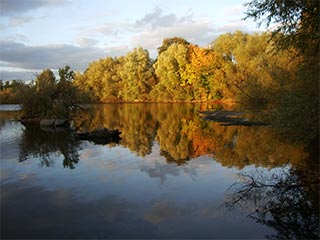
 Following years of campaigning through legal channels, and the squatting of a building by the side of Thrupp Lake at the beginning of 2007, the Save Radley Lakes campaign is victorious – hoorah! Use the search above for old stories and photos from the campaign – stories about the recent victory and future plans are below.
End of an Era
Yesterday’s (17.12.08) announcement by RWE Npower brought to an end a 41 month campaign to save the last remaining Radley Lakes, Thrupp and Bullfield Lakes, from destruction by being filled with waste pulverised fuel ash (PFA) from the Didcot A Power Station.
It also brings to an end 23 years of filling of old gravel pits in Radley with power station ash, which began in 1985, when the Power Station was run by the nationalised Central Electricity Generating Board and when the environment figured less highly in popular concerns. The choice back then was between landfill with general waste, commercial exploitation, or ash. Local people voted for the ash, which is probably what they would have got anyway.
The ash had been pumped into the gravel pits as a slurry via an underground pipeline. Many gravel pits were filled in this way over the intervening years and people did not seem to mind, though eyebrows were being increasingly raised, and there were objections to the filling of Lakes H and I, which had become a spectacular haven for wildfowl. In 2005, RWE npower sought permission to fill the the two remaining gravel pits. These were the oldest excavations, which had, over the half century or so of their existence, become restored into beautiful lakes and had been given names by local people.
How the Lakes Were Saved (in a nutshell)
The smaller Bullfield Lake was rescued from this fate following protests back in 2005, but the much larger and more important Thrupp Lake has remained under threat ever since, as planning, legal and other battles raged around it. As a last resort, local people even applied to have the area turned into a Town Green. This too failed, but it remains the subject of a Judicial Review, which was due to be heard in the High Court in February 2009. In February 2007, having got all necessary planning permissions and removed the protestors who’d occupied the lakeside building, npower went ahead with clearance work on the site, and many trees were destroyed. Work then had to stop until the Autumn, because of nesting birds. After carrying out some preliminary work in October 2007, npower suddenly ceased their activities on the site.
Then, in February 2008, events took an unexpected turn: npower announced an interim reprieve for Thrupp Lake. A little later, Waste Recycling Group (WRG) openly came forward with a proposal that would save Thrupp Lake for ever. It has taken until now to bring this to fruition. Planning permission was needed, technical problems had to be resolved, a commercial agreement had to be reached; then there was the question of what to do with Thrupp Lake. Many delicate negotiations, it seemed, were going on in the background, culminating in yesterday’s momentous announcement.
Triumph at Last!
To mark the occasion, the Power Station operators invited press and public into the grounds of Sandles, the house on the shore Thrupp Lake. There, Mr John Rainford, the Power Station manager, announced that, because the power station had found better and more sustainable ways of disposing of its ash, there would be no need to destroy Thrupp Lake, not now, not ever. He made it clear that RWE npower was offering The Lake to the local community as a nature conservation area and that discussions were underway with the Northmoor Trust to provide for its management. It was hoped that the house could be converted into an educational centre.
Representatives of the community, Jenny Standen, chairman of Radley Parish Council, and Basil Crowley, chairman of Save Radley Lakes, expressed their satisfaction and delight, thanking npower for their magnanimity and looking forward to working with them in restoring the area to create something to be really proud of. Both expressed gratitude to all the people who had supported the campaign and whose support and tireless efforts had helped bring this about.
With the late December afternoon sunshine casting long shadows across the vestiges of Sandles’ lawn, a jubilant party atmosphere prevailed. Champagne flowed, hands were shaken, cameras clicked and, in a touch of surreality, a man in a frog suit played a solo trombone fanfare at the lakeside to herald the lake’s salvation.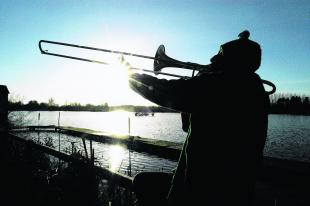
Where the Ash Will Go
The ash that was to have gone into Thrupp Lake will now go to Waste Recycling Group’s Sutton Courtenay landfill site next to the power station where it will be used for engineering, capping and landscaping of the landfill operations. Surplus ash will be stockpiled in a planned new storage facility, which received planning permission back in July, and will maintain WRG’s essential supply of ash after 2015 when the power station will have closed. Because the power station and the waste site are immediately adjacent, the ash can be transported directly across the fence and put into the stockpile, which is not far from the power station boundary. At no time will this ash be transported on public roads, which means there will be no adverse impact on the residents of Sutton Courtenay. Indeed, it will remove the need to import over half a million tonnes of substitute materials after 2015, which would have had an impact!
http://www.saveradleylakes.org.uk/
http://www.radleyvillage.org.uk/news/News0009.htm