

At the crack of dawn, Tuesday, 6th May, after a long night of preparation, Earth First! activists from all across England jumped into two vehicles and speed towards south Manchester, dead set on taking some effective action against the ecologically destructive plans of notorious chemical company BASF. There was no desire for symbolic protest, but simple action that hit hard at the one thing they value the most, their pockets.
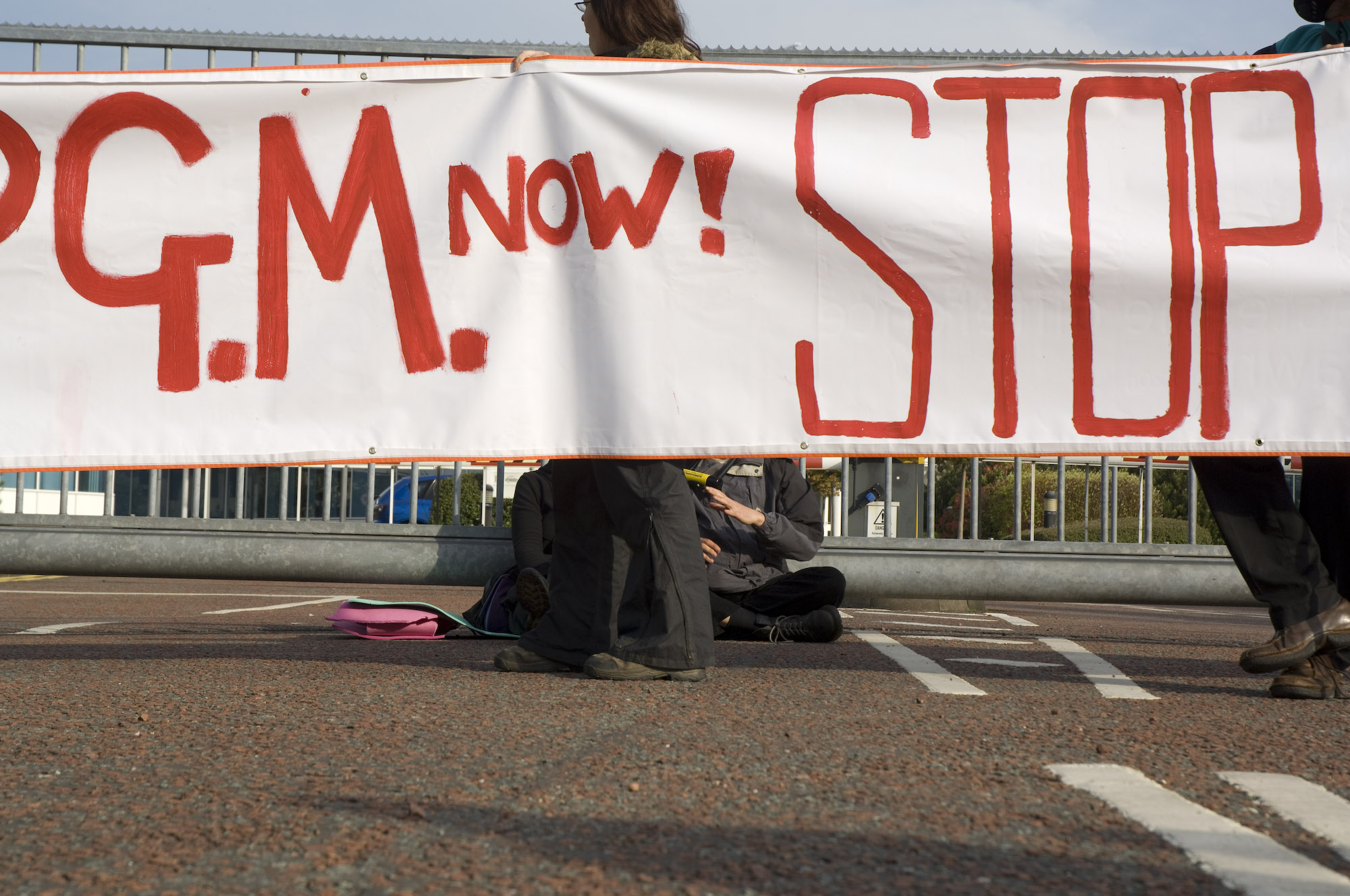
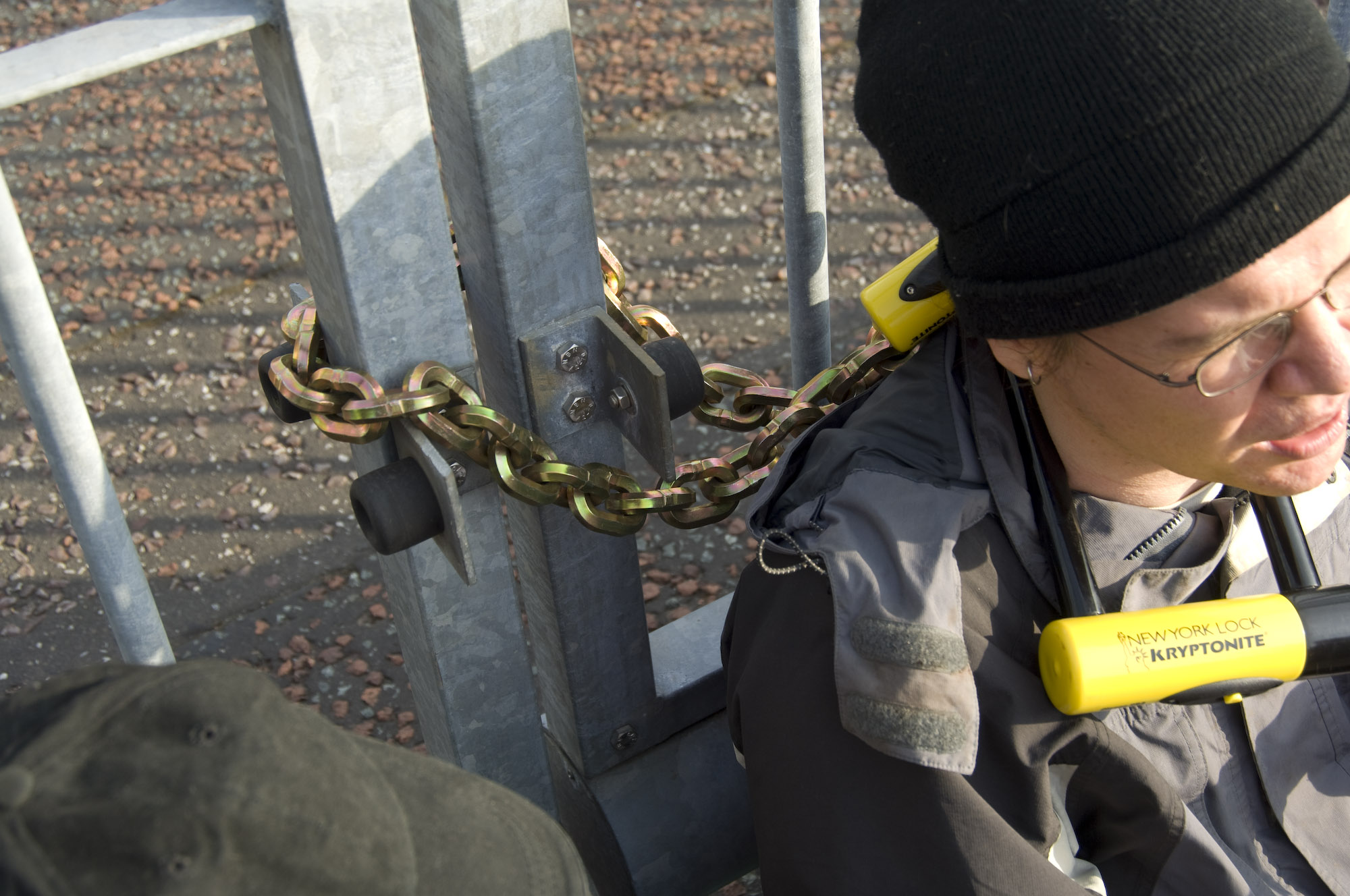
At 7.20 am they turned hard into the only entrance to BASF’s headquarters in Stockport, vehicles blocking the entrance while various affinity groups piled out and got to work. A team of eleven people with lock-on tubes took the ground in front of the long gate, while others D-locked several side gates that were for pedestrian use only.
Meanwhile, some people spoke to the guards and were told that he wanted to shut the gate. Which was excellent news, and there was a rapid change of plan. The arm-tubes were put back in the vehicles, which disappeared off, to be used for the next action, and once the gate was closed a seriously heavy-duty motorbike chain was wrapped around it and one activist D-locked himself to it. And that was us there until 12noon, job done, BASF’s UK headquarters shut down for the morning.
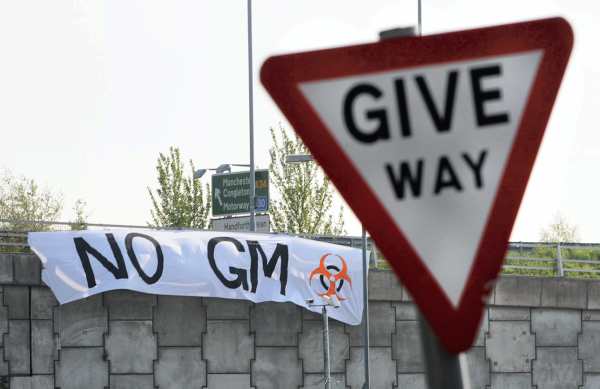
A 30×10 foot banner saying Stop GM was hung from a nearby flyover so everyone would get the message as to why were there. Though, given we were on the border with Cheshire, one confused local inhabitant was curious as to what we had against Greater Manchester!
The only trouble came from the various BASF executives clearly eager to get to their phone conferences and thought driving at people constitutes acceptable behaviour. With such a casual attitude towards protestors standing in their way it is hardly surprising that they do not give a damn about what effect their products have on the rest of the world.
The weather was wonderful, sunny and warm, and we relaxed on the road while all the BASF workers were told to drink coffee in M&S or sit in the B&Q carpark – which naturally were leafleted so they had something to read while they waited. The police, when they turned up, were polite and clearly outnumbered by the protestors, so let them get on with it. There was a police liaison to keep things happy, and when the blockade was lifted, and everyone left with all their equipment – including the D-Locks and chains – and their were no arrests. The only thing they wanted was the large Sainsburys banner which had been redecorated with anti-GM messages, which they wanted to return to Sainsburys in case it had been stolen. We could not say fairer than the police delivering our anti-GM message back to the supermarket chain…
Though we were only there for the morning, the activists left on our own terms, knowing that the impact would continue to reverberate through the company. Evidence from other actions shows that the impact does not stop once the blockade is lifted, but the entire day will be lost. Meeting will have to be rescheduled, work-time caught up on, other offices will be furious about not being able to get in touch, and so on. And the bosses will still be paid for the time spent twiddling their thumbs. An excellent day out… if it could not be spent on the allotment, the next best place is lying on a roadway.
The pressure on GM companies has not gone away.
——————
Press release:
BASF UK HQ currently completely blockaded by protesters.
This morning 30 protesters from Earth First! have shut down the BASF UK headquarters (1) at Cheadle Hulme near Manchester (2), to highlight the company’s role in pushing GM onto our plates. BASF is planning to run the UK’s only trial of GM crops this year, a trial of blight resistant potatoes.(3)
The protesters arrived early in the morning at the flagship offices and have since been blockading the gate by sitting in front of it and locking on using d-locks and other equipment. They are successfully preventing any staff from
entering and are demanding the company pull out of GM immediately. They have also hung a giant 30 x 10ft banner reading “No To GM”. The protesters are planning to blockade the gate for several hours.
Mary Sunderland from Earth First! Said: “GM has no part to play in our future: it’s a dangerous, unwanted and unproven technology geared towards maximising profits for multinational corporations such as BASF. It is not the answer to food shortages, hunger or climate change. The real solution is to change now to a sustainable farming system and to distribute resources fairly around the world.”
The bio-tech industry claims GM will feed the world’s poor, but experts disagree. A major new study published in April shows that modified soya produces 10 per cent less food than its conventional equivalent, confirming earlier studies showing the same trend. The study finds that the very process of modification depresses productivity.(4)
This revelation came just a week after the biggest study of its kind ever conducted,the International Assessment of Agricultural Science, concluded that GM was not an answer to world hunger. The UN study, conducted by over 400 scientists and approved by over 54 governments is a sobering account of the failure of industrial farming. The key message of the report is that small-scale farmers and agro-ecological methods provide the way forward to avert the current food crisis and deal with the effects of climate change.(5)
Neil Ross from Earth First! UK adds: “It’s time for everyone who is concerned about the future of our food and environment to stand up again and to say ‘No to GM’. When five years ago 86 per cent of the UK public said that they did not want GM foods the government and bio-tech industry brushed those concerns aside as unscientific. Science is now proving that we were right to oppose GM. Thanks to the courage of many ordinary people who ripped up GM crops our countryside has been GM free for the past four years. (6) We are determined to keep it that way. The message to BASF and
the government couldn’t be clearer. Stop wasting money on GM (7) and start investing in the real solutions to hunger: small-scale organic farming and equitable trade.”
_
Notes
(1)BASF is the world’s leading chemical company.
(2) Heading south from Manchester on the A34 , turn right onto Stanley Road (B5094). Take the second left onto Earl Road. Continue under the flyover (Manchester Airport Eastern Link Road) and BASF HQ is on your right.
(3) The UK trials of BASF’s blight resistant potatoes were due to take place from last spring at two locations for a period of five years. One site is a research centre in Cambridge, where last year anti-gm campaigners succeeded in destroying the field during a night time raid. The second trial site was never planted as BASF was unable to find a site for it. Campaigners have already vowed to decontaminate the Cambridge site again, should BASF go ahead with the controversial trial. Many believe that the trials are unnecessary as blight resistant potatoes are already available
through conventional breeding.
(4) The study was carried out over the past three years by the University of Kansas in the US grain belt and published by Professor B Gordon in the journal ‘Better Crops’. He grew a Monsanto GM soy bean resistant to the herbicide Round-up and compared it with a conventional variety. The GM bean produced only 70 bushels per acre compared to 77 bushels for the conventional bean.
(5) The report from the United Nations World Food Programme, the International Assessment of Agricultural Science and Technology for Development (IAASTD) called for a back-to-basics approach to farming to meet the challenges of climate change and escalating food prices. The authors saw little role for GM technology in feeding the poor. The report
was based on a rigorous and peer-reviewed analysis of the empirical evidence by hundreds of scientists and development experts. http://www.agassessment.org/
(6) When GM crop trials started in the UK in 1998, no one could have predicted the public opposition to it. Within just 5 years, all GM companies including Monsanto, Syngenta and Bayer had retreated from Britain, numerous field trials had been destroyed and a moratorium against GM crop growing had been imposed.10 years later, Britain is still free from any commercial growing of GM crops. This opposition has also sparked massive resistance elsewhere in Europe.
(7) Using the Freedom of Information Act Friends of the Earth managed to obtained still partial information in October 2007 which shows that the Government gave at least £50 million a year for research into GM crops and food, compared with £1.6 million for research into organic agriculture last year, in spite of repeated promises to promote environmentally friendly, sustainable farming. http://www.i-sis.org.uk/dirty_GM_secrets.php
manchester[at!]earthfirst.org.uk
http://www.earthfirst.org.uk
——————