
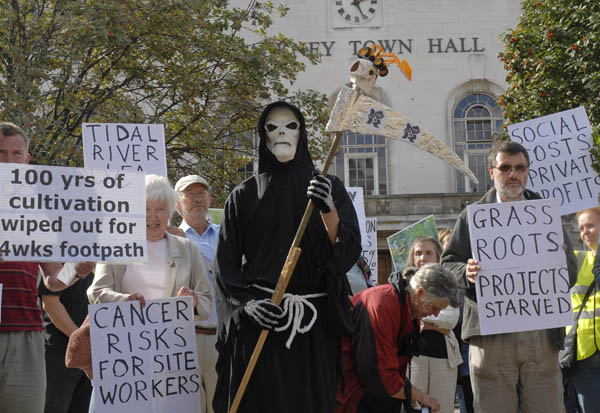
 Sunday the 23rd September was a sad day in the history of gardening. It was the day the Manor Gardens Allotments were closed by the Olympic Delivery Authority.
It was also the day former allotment holders and many other people decided to march and demonstrate their concern over the way in which development and so called regeneration is soaking up much needed green space. Martin Slavin an Olympic researcher was on the march and comments “ … so called regeneration projects like the Olympics are more about the careers of those involved in the Olympic industry, and the profits of developers and construction companies than they are about improving the lives of ordinary people”.
The Manor Gardens Allotments, were a little piece of the countryside in London, and were given to the gardeners of East London by Mayor Villiers, an old fashioned philanthropist, he was dedicated to improving the life of working class Eastenders by a transfer of resources from him (rich) to the people of East London (poor). As well as the allotments, the Olympic project has swallowed up a huge chunk of land in East London, most of it compulsorily purchased. The acquisition of the Olympic Park land is virtually a mirror image of what Major Villiers did all those years ago.
The compulsory purchase of the Olympic Parkland has been funded by public money, and as such it can be argued that it should stay in public ownership, post Olympics, however, exactly what will happen to the land remains undecided, but both Ken Livingstone and Ruth Kelly have publicly stated that they plan to bank role the Olympic project by selling off land within the park to developers when the Games are over. Major Villiers would no doubt turn in his grave, as his beautiful allotments along with virtually the whole STATE AREA site is bulldozed for a project which will most likely result in a transfer of land from public to private ownership. As the Olympic project runs further and further into financial difficulty the pressure will be on to claw back as much money as possible. This will inevitably mean getting into bed with property developers who, along with the construction companies, will be the main beneficiaries of a project that has been flawed from the very beginning.
An added tragedy to this story is that much what will form Olympic Park was previously available for use, on a non-income dependent basis, a cycle circuit, allotments, social housing, football pitches, little nooks and crannies, were all sorts of marginal business and artists had found a foothold. There was also a rave scene at Hackney Wick, with tired and dazed ravers leaving parties on Sunday mornings whilst the well dressed congregations of the many African Churches filed by. It was an area that had grown organically over more thaan a century and though it has some rough edges the area had an authenticity rarely found in 21st century London. This has been lost to what will more than likely be an Olympic legacy of expensive flats within gated communities, a sterile, privately owned area similar to the docklands.
It would be impossible to sell the Olympics to the nation for 3 weeks of sport, it is simply too expensive, so those making their living out of this project have marketed it on the supposed benefits of a legacy which remains unplanned. One of the problems is that New labour has control of the project, it has central government backing and with New Labour also controlling all 4 of the boroughs in which the Olympic Park is situated, and with the Olympic Delivery Authority awarding planning permission to itself the Olympic project can be pushed through virtually unchecked.
Sunday’s march from Hackney Town Hall to the new security gates of the Olympic construction site was a sign of the public’s misgivings over this deeply flawed project. After the march there was a meeting where discussions were held relating to development and regeneration. One interesting point covered in this discussion was the way these large projects evolve. First plans are made, then a so-called consultation takes place and then the work begins. However the meeting agreed that the consultations were generally a public relations exercise and that they made little difference to the outcome of projects, which are usually forced through despite any public misgivings. The Olympics appears to be a case in point.